
By Jeff Mason, Andrew Hay and Diego Oré
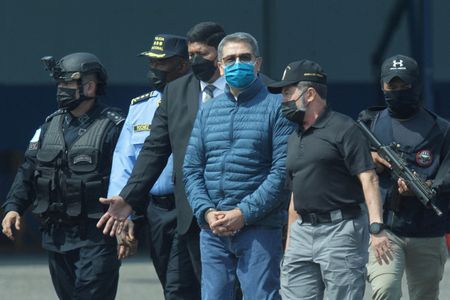
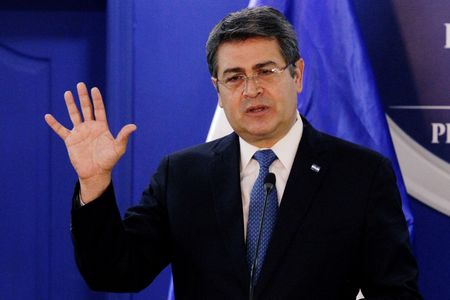
WASHINGTON, Dec 2 (Reuters) - President Donald Trump, who has cast himself as a relentless foe of illegal drugs, pardoned former Honduran President Juan Orlando Hernandez, freeing him from a 45-year sentence for conspiring to import tons of cocaine into the United States.
Trump’s extraordinary move risks weakening U.S. credibility in Latin America, could embolden corrupt actors, and is likely to draw criticism that he is undercutting decades of U.S. efforts to fight transnational drug networks.
Trump told reporters at the White House that he had freed Hernandez in response to pleas from Hondurans and that he felt "very good" about the decision. He asserted without evidence that Hernandez had been the victim of a witch hunt by the administration of his Democratic predecessor, Joe Biden.
Democrats rebuked the Republican president, accusing him of hypocrisy in claiming to have stepped up the fight against the flow of illicit drugs into the United States while freeing a man convicted of using his office to aid drug traffickers.
Senator Dick Durbin, the top Democrat on the Senate Judiciary Committee, said evidence presented at Hernandez's trial had established that the former president had "orchestrated a vast trafficking conspiracy" that raked in millions of dollars for drug cartels.
"This is not an action by a president trying to keep America safe from narcotics," Durbin said. "It is a strange understanding of his power that he would use this and not penalize those responsible for the narcotics coming into the United States."
Trump has cited the dangers of illicit drug flows from Latin America as justification for a series of deadly U.S. attacks on boats in the Caribbean and eastern Pacific, and a military buildup near Venezuela. Democrats and legal scholars have criticized the attacks and questioned their legal justification, noting that they have killed at least 80 people.
During the Biden administration, the U.S. Justice Department asserted that Hernandez, who was president from 2014 to 2022, had run Honduras as a "narco-state", abusing his power by accepting millions of dollars in bribes from traffickers to protect their U.S.-bound cocaine shipments and to fuel his rise in Honduran politics. A Manhattan jury found Hernandez guilty in March 2024.
The Justice Department said he had been at the "center of one of the largest and most violent drug-trafficking conspiracies in the world" and used his authority to facilitate the importation of more than 400 tons of cocaine into the U.S.
"It’s not just a matter of reputation or credibility. Pardoning Juan Orlando is directly damaging to the United States’ national interests," said Will Freeman, fellow at the Council on Foreign Relations think tank.
Honduras became a global hub for cocaine exports after a 2009 coup created political instability and allowed drug cartels to gain influence. The poverty-stricken country of around 11 million became one of the most violent places on earth as rival groups fought to control trafficking routes.
During Hernandez's 2014-2022 presidency hundreds of thousands of Hondurans fled extortion and gang violence by migrating to the United States.
HERNANDEZ CLAIMS PERSECUTION
At his sentencing, Hernandez argued that the traffickers had testified against him because he had helped extradite them from Honduras to the United States. “This was a political persecution by drug traffickers and politicians," Hernandez said then, according to the court transcript.
In prison, Hernandez wrote a letter to Trump in which he called himself a political target of the Biden administration, comparing himself to the current U.S. president, who faced multiple prosecutions during Biden's presidency and claimed the charges were politically motivated.
Hernandez's attorney, Renato Stabile, told Reuters the case against Hernandez was built on the flimsy testimony of “people who chopped people’s heads off, people who chopped off body parts.”
“I think the story here is that President Hernandez was quite in line with President Trump's agenda. And I think President Trump realized that. And he also realized that this was a wrongful prosecution and he didn't like what he saw,” Stabile said.
Stabile said Hernandez was still in the U.S. and it was not safe for him to return to Honduras, citing the risk of possible assassination by cartel members.
STONE INTERVENES
Trump has wielded his pardon power in ways no modern president has. After issuing 70 pardons in the first 10 months of his second term, he is on track to greatly surpass the number of pardons issued by his 21st century predecessors.
Trump signed the pardon for Hernandez on Monday night, a White House official said. The Federal Bureau of Prisons released him from prison in Hazelton, West Virginia, on Monday.
Roger Stone, a South Florida-based conservative commentator and Trump ally, had for months advocated for Hernandez's release. He said on his radio show on Sunday that he had given Trump Hernandez's letter.
On the show, Hernandez's wife, Ana Garcia de Hernandez, said Stone's advocacy for her husband had made a "huge difference" in the president's decision.
The White House official said Trump had not seen the letter before announcing his intent to pardon Hernandez on Friday.
Stone did not respond to requests for comment.
Hernandez's release came a day after a presidential election in Honduras, in which Trump has backed presidential candidate Nasry Asfura of the conservative National Party, who is facing off with liberal Salvador Nasralla. The latest vote count showed both candidates practically tied, with each holding just under 40% of the vote.
Enrique Reina, the vice presidential running mate for Rixi Moncada of the ruling LIBRE party, criticized Hernandez's release in a post on X.
"The planet is succumbing to the breakdown of all norms, based on threats and violations of every rule and principle. Those who remain silent — or worse, those who are complicit — are part of the rise of something that threatens more than just Honduras," Reina said.
(Reporting by Jeff Mason, Diego Ore, Andrew Hay and Trevor Hunnicutt; additional reporting by Roselle Chen, Aida Pelaez-Fernandez, Stephen Eisenhammer, Nathan Layne, Katharine Jackson, Patricia Zengerle; Writing by James Oliphant; Editing by Daina Beth Solomon, Ross Colvin, Nick Zieminski and Alistair Bell)