
By Olivia Le Poidevin
GENEVA, Dec 4 (Reuters) - National broadcasters behind the Eurovision Song Contest meet on Thursday to discuss whether Israel should be barred from participating next year, amid threats by some to pull out over the Gaza war.
The meeting in Geneva marks a watershed moment for the competition which draws millions of viewers worldwide.
The Spanish and others national broadcasters have threatened to boycott the event if Israel is included, citing the death count in Gaza, and accused it of not following rules meant to guard the contest's neutrality.
Germany, a major Eurovosion backer, has said it will not take part if Israel is barred. Israel, which came second in the contest this year, has not responded to the accusations, but has argued it faces a global smear campaign.
CONTEST ATTRACTS MORE VIEWERS THAN SUPER BOWL
The meeting will discuss new rules intended to discourage governments from overly promoting songs to sway voters, following allegations that Israel unfairly boosted its entrant this year.
If members cannot agree on those, they may hold a vote on Israel's participation, the European Broadcasting Union, which organises the contest, said.
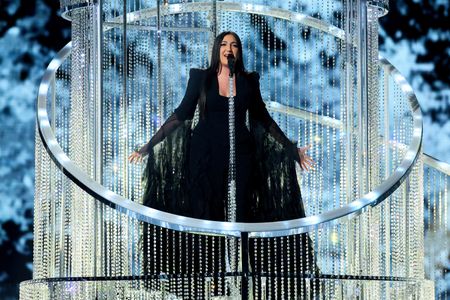
Israel's 2025 entrant, Yuval Raphael, was at the Nova music festival, one of the targets of the October 7, 2023 Hamas attack on Israel that triggered the Gaza war.
A total 1,200 people were killed and 251 taken hostage in the assault by Palestinian militant group Hamas, according to Israeli tallies. More than 70,000 people have been killed in Gaza in the ensuing conflict, according to health authorities in the enclave.
Israeli public broadcaster KAN said it is preparing for next year's contest and will soon release changes to its entry selection process. KAN added it will present its position on possible disqualification at the meeting.
Public broadcasters from Slovenia, Ireland, Spain and the Netherlands are threatening to boycott the May 2026 event, to be hosted by Austria, if Israel competes.
The Eurovision Song Contest, which dates back to 1956, reaches around 160 million viewers, according to the EBU. By contrast the U.S. Super Bowl this year drew almost 128 million, according to Nielsen, which measures global media audiences.
If members are not convinced that the new rules, which aim to protect the contest's neutrality and impartiality, are adequate, there will be a vote on participation, the EBU said.
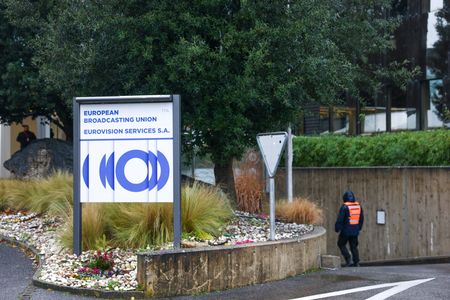
As he arrived at the meeting at the EBU headquarters, the president of Portugal's RTP national broadcaster, Nicolau Santos, told Reuters his organisation supported the new rules, without commenting on Israel's participation.
Finnish broadcaster Yle said it would only take part in the next contest if the proposed rules were implemented and if there were additional safety guarantees for participants and the audience.
"Eurovision's original purpose has been to create a space where we can meet despite differences and disagreement," Yle's CEO, Marit af Björkesten, said in a statement, adding that the contest must not be used for political influence.
GERMAN MINISTER BACKS ISRAEL'S PARTICIPATION
German Minister of State for Culture, Wolfram Weimer, told Reuters that Berlin should not participate if Israel was excluded.
"Israel belongs in the Eurovision Song Contest," he said. "There must be no ESC without Israel."
A spokesperson for German broadcaster ARD said: "We hope for constructive discussions and solutions within the EBU that are consistent with the values of the EBU and the ESC." Austrian host broadcaster ORF wants Israel to compete.
Under the new EBU rules, an expanded professional jury will be reintroduced at the semi-final stage and will have about 50% of the vote. The other half will remain a public vote.
Audience members will now have a maximum of 10 rather than 20 votes to cast and are encouraged to support multiple entries, the EBU stated.
(Reporting by Olivia Le Poidevin; Additional reporting by Andreas Rinke in Berlin, Emma Pinedo Gonzalez in Madrid, Klaus Lauer in Berlin, Gerhard Mey and Marie-Louise Gumuchian in London; Additional reporting, John Cotton and Cecile Mantovani in Geneva and Elviira Luoma in Gdansk; Editing by Toby Chopra, Alexandra Hudson and Andrew Heavens)