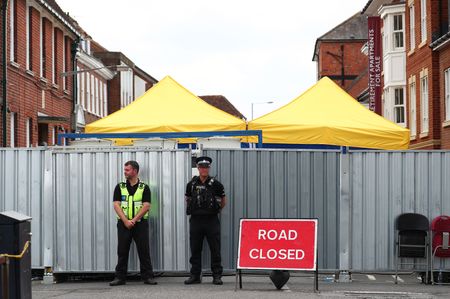

LONDON, Dec 4 (Reuters) - A British public inquiry will deliver its findings on Thursday into the death of a woman who was unwittingly killed by the Novichok nerve agent following the attempted murder of former Russian double agent Sergei Skripal seven years ago.
British authorities have blamed Russia for the attack on Skripal, who was found along with his daughter Yulia slumped unconscious on a public bench in the southern English city of Salisbury in March 2018 after Novichok was applied to the front door handle of his home.
Four months later, mother-of-three Dawn Sturgess, 44, died from exposure to the poison after her partner found a counterfeit perfume bottle which police believe had been used by Russian spies to smuggle the military-grade nerve agent into the country.
ENOUGH NERVE AGENT TO KILL THOUSANDS
The Skripals, and a police officer who went to Skripal's house, were left critically ill from its effects, but recovered. At its opening, the inquiry was told the contaminated perfume bottle had contained enough poison to kill thousands of people.
British police have charged three Russians in absentia who they say are GRU military intelligence officers, over the attempted murder of Skripal, who sold Russian secrets to Britain and moved there after a 2010 spy swap, and his daughter.
Two of the Russians accused by Britain of carrying out the poisoning later appeared on Russian TV to deny involvement, saying they had been innocent tourists visiting the city's cathedral. All three have denied any involvement.
No one has been charged over Sturgess's death.
Both the British government and Skripal himself have accused Russian President Vladimir Putin of authorising the attack.
"I believe Putin makes all important decisions himself. I therefore think he must have at least given permission for the attack on Yulia and me," Skripal, who said he knew Putin personally, said in a statement to the inquiry.
Russia has repeatedly rejected British accusations that it was involved, and says London is guilty of spouting anti-Russian rhetoric.
The Salisbury incident triggered the biggest East-West diplomatic expulsions since the Cold War, and relations between Moscow and London have deteriorated still further since Russia's full-scale invasion of Ukraine in February 2022, with Britain providing large amounts of military aid to Kyiv.
The inquiry has heard evidence in secret from the UK security services, including details of Skripal's relationship with British intelligence agencies. The Skripals themselves did not give evidence in person because of fears for their safety.
(Reporting by Michael Holden; editing by Mark Heinrich)