
By Alexander Ratz
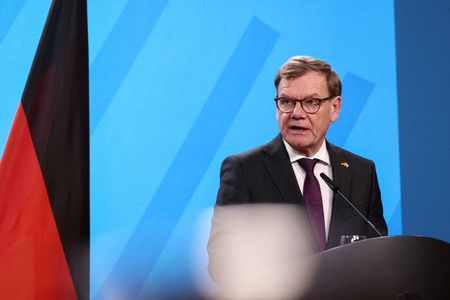
BEIJING, Dec 8 (Reuters) - German Foreign Minister Johann Wadephul said much work was still needed to persuade Beijing to grant rare earth export licences to German manufacturers, signalling during his first visit to China that they had not received any from the first batch issued.
Chinese export controls on 17 minerals used in areas as varied as autos, consumer electronics and defence had caused months of disruption since their introduction in April due to the U.S.-China trade war.
Reuters reported last week that China had issued its first "general licences" - year-long permits aimed at speeding up exports - after a breakthrough in a summit between Presidents Donald Trump and Xi Jinping. But it remains unclear whether these will only benefit the United States.
Asked by broadcaster ZDF during his two-day trip to China whether he had made progress in persuading Beijing to grant German firms licences too, Wadephul said: "We have received signals but there is still quite a lot of work to be done."
Wadephul said he had discussed the key issue of disruptions in Chinese deliveries of semiconductors, rare earths and other commodities in his meetings on Monday with China's trade minister.
"In all of these areas there has been uncertainty, and that needs to be eliminated," said Wadephul, who is accompanied in China by a small business delegation including Hildegard Mueller, head of the automotive industry association VDA.
Mueller separately urged the European Union to take a "more proactive approach" towards China on the issue.
EUROPE GETTING TOUGHER ON CHINA?
Wadephul's trip was postponed from October at the last minute because China had only confirmed one of his requested meetings.
It comes as Berlin toughens its stance on Beijing over trade disputes and geopolitical conflicts, in line with European partners, albeit seeking to retain good relations with its top trade partner.
Germany last month established a committee of experts to advise parliament on "security-relevant trade relations" with China, part of a push to reduce reliance on China as a supplier of key materials and customer for Germany's industrial exports.
"We must make clear that further bilateral economic relations depend on China ending its unfair practices," said Juergen Hardt, foreign policy spokesperson of the conservatives in parliament.
The European Commission last Wednesday unveiled plans to strengthen trade measures like anti-dumping and anti-subsidy duties and to design new measures to counter unfair trade practices.
Noah Barkin, senior adviser at Rhodium Group, an advisory firm focused on China, said Wadephul needed to make clear that Berlin backed the Commission.
"Wadephul needs to deliver a clear message to his Chinese hosts that they are at risk of losing Germany and Europe if they continue to ignore concerns about the direction of the economic relationship," he said.
"He needs to make clear that Europe will have no choice but to close down its market to Chinese firms unless these concerns are addressed."
The foreign ministry said the trip, which comes days after a visit by French President Emmanuel Macron, had been closely coordinated with EU partners.
CHINESE INFLUENCE ON RUSSIA
Finance Minister Lars Klingbeil last month became the first cabinet minister from Chancellor Friedrich Merz's new, conservative-led coalition government to visit China.
Wadephul confirmed on Monday his visit aimed to pave the way for one by Merz early next year.
Wadephul, who meets his Chinese counterpart later on Monday, will address European security interests, notably Russia's full-scale invasion of Ukraine, the ministry said.
"No other country has as much influence on Russia as China and can exert its weight to such an extent that Russia is finally prepared to engage in serious negotiations that respect Ukraine's sovereignty," Wadephul said.
The talks will also cover the security situation in the contested South China Sea where China's increasingly assertive maritime posture is challenging neighbouring littoral states' claims.
On Tuesday, Wadephul will visit the southern manufacturing hub of Guangzhou.
(Reporting by Alexander Ratz; Writing by Sarah MarshAdditional reporting by Christoph Steitz; Editing by Toby Chopra and Gareth Jones )