
By James Pomfret and Jessie Pang
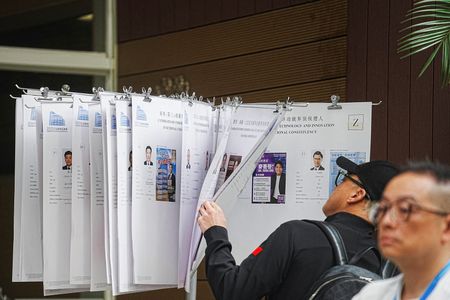
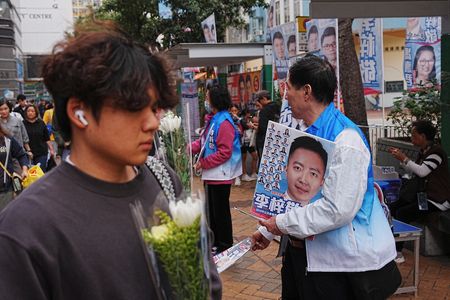
HONG KONG, Dec 7 (Reuters) - Hong Kong's election on Sunday saw a near-record-low turnout after the city's worst fire in nearly 80 years prompted anger against its China-backed authorities, but voter participation edged higher than in the previous vote four years ago.
Only candidates vetted as "patriots" by the government were allowed to run for the global financial hub's 90-seat legislature, with only 20 of those seats being directly elected, and the rest chosen by an election committee stacked with Beijing loyalists, and special interest and professional groups.
Voting hours were extended and new polling stations opened to encourage people to vote.
The government said the final turnout in the Legislative Council election was 31.9%, versus 30.2% in 2021, which was the lowest since the former British colony returned to Chinese rule in 1997. The actual number of votes, however, was slightly less than four years ago.
The fire had changed the "social atmosphere, making it a very difficult election for us to organise," David Lok, chairman of the Election Commission, told a press briefing early Monday.
Security was tight in the northern district of Tai Po, close to the border with mainland China, where the fire engulfed seven residential towers, with large numbers of police patrolling the area around Wang Fuk Court, the site of the fire.
Residents are angry over the blaze that killed at least 159 people and took nearly two days to extinguish after it broke out on November 26. The authorities say substandard building materials used in renovating a high-rise housing estate were responsible for fuelling the fire.
City leader John Lee said the government would now work with the legislature to "drive institutional reform" in the aftermath of the fire, amid some public calls and petitions calling for greater government accountability and for improved oversight over the construction sector.
Eager to contain the public dismay, authorities have launched criminal and corruption investigations into the blaze.
AUTHORITIES MAKE ARRESTS FOR INCITING VOTE BOYCOTT
The city's anti-corruption agency said on Sunday four men were arrested on suspicion of using social media to incite people not to vote or cast invalid votes. It obtained an arrest warrant for another man for a social media post on Saturday.
Publicly inciting a vote boycott was criminalised as part of the sweeping changes that effectively squeezed out pro-democracy voices in Hong Kong. Pro-democracy voters, who traditionally made up about 60% of the electorate, have since shunned elections.
Shortly before midnight, authorities started clearing flowers and other offerings from a memorial site in a small park close to the burned-out residential development, a pre-announced move that suggested government anxiety over public anger.
Beijing's national security office in Hong Kong has said it would crack down on any "anti-China" protest in the wake of the fire and warned against using the disaster to "disrupt Hong Kong".
China's national security office in Hong Kong warned senior editors with a number of foreign media outlets at a meeting in the city on Saturday not to spread "false information" or "smear" government efforts to deal with the fire.
The blaze is a major test of Beijing's grip on the former British colony, which it has transformed under a national security law after mass pro-democracy protests in 2019. Only 20 seats in the legislature are directly elected.
A resident in his late 70s named Cheng, who lives near the charred buildings, said he did not vote.
"I’m very upset by the great fire,” he said, declining to give his full name for fear of becoming a target for authorities.
"I won’t vote to support those pro-establishment politicians who failed us."
The number of registered voters for Sunday's polls - 4.13 million - has dropped for the fourth consecutive year since 2021, when a peak of 4.47 million people were registered.
(Additional reporting by Joyce Zhou, Artorn Pookasook, Angie Teo, Fabian Hamacher, Laurie Chen, Edmond Ng; Writing by Anne Marie Roantree, Marius Zaharia and Greg Torode; Editing by William Mallard, Philippa Fletcher and Stephen Coates)