
By Joyce Lee and Jack Kim
SEOUL, Dec 8 (Reuters) - U.S. President Donald Trump's new global security roadmap has dropped any reference to denuclearising North Korea as a goal, fuelling speculation that Washington may be angling to boost the chances of a diplomatic breakthrough with Pyongyang in 2026.
The target of ending North Korea's nuclear threat had been a constant in the National Security Strategy of every U.S. president since the emergence of Pyongyang's programme in 2003, but was conspicuously absent in Friday's document.
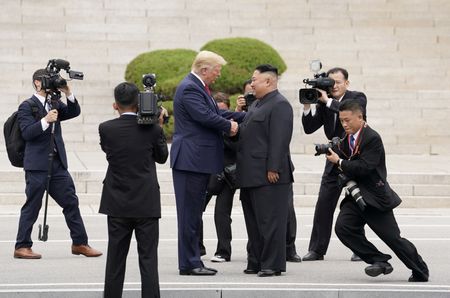
The omission of any mention of North Korea and its accelerating programme to build nuclear weapons that can be delivered by ballistic missiles capable of striking the mainland U.S. is fanning expectations of a potential revival of talks between Trump and Kim Jong Un, last held in 2019.
Trump has spoken of his willingness to sit down with the North Korean leader in a "proactive" way, indicating he "wants to get something done by taking some action," said Hong Min of the Korea Institute for National Unification.
"Then I think there is a certain degree of conscious intent there, that the idea of denuclearisation ... really doesn't need to be brought up here," said Hong, an expert on Pyongyang's strategic thinking.
In Trump's previous security blueprint issued during his first term in 2017, North Korea was mentioned 16 times as a threat to "our homeland" and a rogue state that could "use a nuclear weapon against the United States."
This year's document lays out Trump's vision of "flexible realism", which focuses on containing conflict with China over Taiwan by boosting the military power of its allies in Asia, chiefly South Korea and Japan.
KIM JONG UN'S VIEW
Both South Korea and the United States on Monday denied there was any policy shift on North Korea, stressing denuclearisation remains the goal.
Still, Kim has made clear that the issue of whether he could come back for talks hinges on their nature, and that he and Trump would have to meet as equal leaders of nuclear states.
"The concept of 'denuclearisation' has already lost its meaning. We have become a nuclear state," Kim told parliament in September. "I say 'denuclearisation' is the last, last thing to expect from us."
"If the United States, freeing itself from its absurd pursuit of others' denuclearisation and recognizing the reality, wants genuine peaceful coexistence with us, there is no reason for us not to come face to face with it," Kim said.
Analysts say peace talks with Trump would cement Kim's standing at home as a world leader and prove to his impoverished people that he had delivered on a promise that his father and grandfather were unable to keep.
The pair held summits in 2018 and 2019 before negotiations collapsed over Pyongyang's nuclear weapons arsenal. North Korea is under heavy international sanctions over those weapons and its ballistic missiles programme.
STARS ALIGNING FOR TALKS?
Since the U.S. document release, South Korea has emphasised that it believes the stars may align for the restart of talks with North Korea next year and that signals from key players, ranging from the U.S. to China and Japan, are good.
"What we've done so far has produced results in terms of creating the right conditions to advance the peace process on the Korean peninsula," Wi Sung-lac, South Korea's national security adviser, said on Sunday.
Meanwhile, South Korea has been quietly bolstering its own defensive power, pledging to boost military spending to 3.5% of GDP by 2035 with a 7.5% increase for next year in keeping with demands from Trump.
U.S. Defense Secretary Pete Hegseth praised South Korea on Saturday for being a "model" ally that "will receive our special favour" for agreeing to "assume the leading role in ... conventional defence. We are optimistic that other Indo-Pacific allies will follow suit."
In talks with Trump in October, South Korean President Lee Jae Myung won approval to build nuclear-powered submarines with U.S. help in supplying fuel, given Seoul's commitment to be free of nuclear weapons.
(Reporting by Jack Kim and Joyce Lee in Seoul, Additional reporting by John Geddie in Tokyo; Editing by Ed Davies and Saad Sayeed)