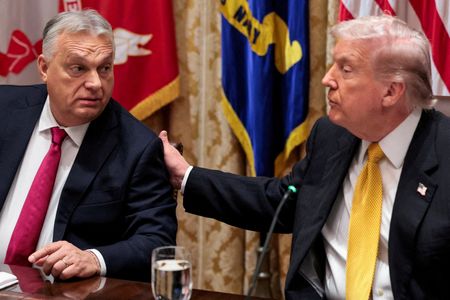

BUDAPEST, Dec 9 (Reuters) - Hungarian Prime Minister Viktor Orban and U.S. President Donald Trump did not agree on a proposed $20 billion financial lifeline but committed to start talks on a new form of financial cooperation, Hungary's foreign minister said on Tuesday.
Peter Szijjarto was reacting to an interview published earlier in the day by Politico in which Trump denied offering any financial lifeline.
Last month, Orban suggested Hungary could choose from several facilities to shore up its finances under an agreement with Washington, with funding worth up to $20 billion.
Orban, a nationalist leader facing a tight election next year, met Trump at the White House on November 7. During the meeting, he secured a one-year waiver from U.S. sanctions for using Russian energy. Afterwards, Orban said Hungary might be able to tap a currency swap line or a flexible credit line, subject to Trump's approval.
"No, I didn't promise him (Orban), but he certainly asked for it," Trump told Politico when he was asked about the possible financial shield for Hungary.
On Tuesday, Szijjarto said that at the meeting between Trump and Orban "no agreement was in fact reached on any $20 billion, just as no one had claimed."
"What they agreed on, however, was that we would begin consultations on a new type of financial cooperation, its possible forms, and a mechanism that could offer financial protection," Szijjarto wrote on Facebook.
Facing a third year of stagnation, Orban's government has rolled out tax cuts for families, wage hikes, food vouchers for pensioners, and other measures to bolster support ahead of the election.
Hungarian officials have previously said that potential U.S. financial support would show Hungary can find alternatives to EU funding, which remains frozen in a dispute over Orban’s rule-of-law reforms that critics say undermine democracy.
(Reporting by Anita Komuves and Krisztina Than;Editing by Ros Russell)