


By Giselda Vagnoni
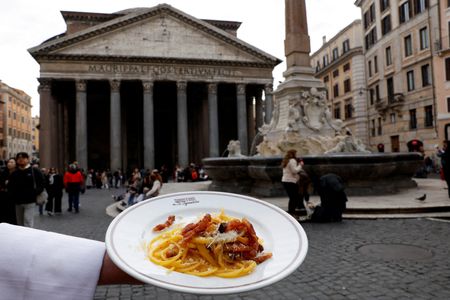
ROME, Dec 10 (Reuters) - Italians hailed UNESCO's recognition of their cuisine on Wednesday as a win for cultural diplomacy but critics warned it could backfire by turning popular dishes into bland tourist fare.
A sound and light show at the Colosseum in Rome on Wednesday night will celebrate a successful bid that framed Italian food not just as a set of recipes but as a living heritage rooted in seasonality, community and shared rituals.
"Italian cuisine is our most formidable ambassador," Italy's Prime Minister Giorgia Meloni said in a video message.
The listing could deliver further economic benefits to a country already renowned for its cooking and where the agri-food supply chain accounts for about 15% of the national GDP.
It could also bring some relief to traditional family-run restaurants, long the backbone of Italian dining, which are facing a harsh economic climate in a market increasingly polarised between premium and budget options.
Neapolitan pizza-making's 2017 UNESCO listing drove a 284% jump in professional courses, according to a study by Rome's Unitelma Sapienza University, while agritourism in the southern Italian island of Pantelleria grew 500% over a decade after its vine cultivation was inscribed in the UNESCO list.
"I'm truly happy about this recognition," said Manuela Menegoni, who runs Trattoria Bianca and Osteria Fernanda in Rome with her chef husband Davide Del Duca.
"I hope it will spur job creation, drive investment in innovation and deliver tax incentives across the entire food supply chain, which has long been overlooked by policymakers," she added.
Industry groups estimate UNESCO recognition could boost tourism by up to 8% in two years, adding 18 million overnight stays.
However, researchers warn that such gains often come with overtourism pressures, as seen in Venice and the Prosecco hills in the northeast, where UNESCO status has drawn crowds beyond local capacity.
ITALIAN CITY CENTRES RISK LOSING CHARACTER
Italy's historic city centres are increasingly at risk of becoming what critics call gastronomic theme parks.
"Bologna has become a 'mangificio' (food factory). Checkered tablecloths and straw chairs are everywhere, in an invention of tradition for the benefit of external consumers," said Alberto Grandi, a food historian and author.
In an interview with Reuters he shared his concern about the risk of food gentrification, a process where traditional, affordable, and culturally rooted foods or food practices are transformed into upscale, trendy, and often expensive versions.
"If the goal is to save Italian gastronomic culture, it will be the exact opposite," he said.
"This is a marketing ploy that sells a standardised vision of Italian cuisine linked to a dozen dishes that must be offered everywhere because tourists expect them. This is to the detriment of a deeper understanding of Italian culinary history, which is being lost," he added.
Restaurant owner Menegoni said that the challenge now is ensuring the accolade strengthens everyday practices rather than feeding into low-budget mass tourism — sandwiches and pizza slices of the kind proliferating during the 2025 Jubilee in Rome.
"Our best foreign clients told us, 'See you next year,' because they avoid crowds and prefer exclusive experiences that only quality venues can offer," she said.
"Any effort to promote Italian cuisine worldwide is welcome," she added.
(Reporting by Giselda VagnoniEditing by Keith Weir)