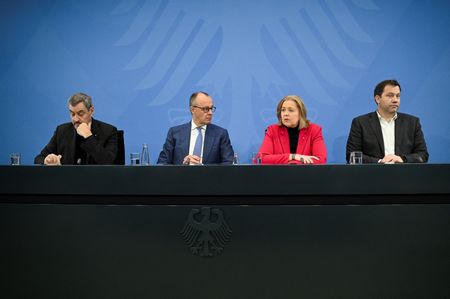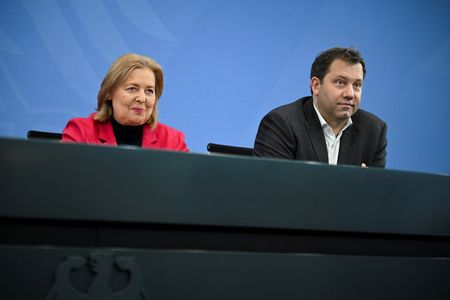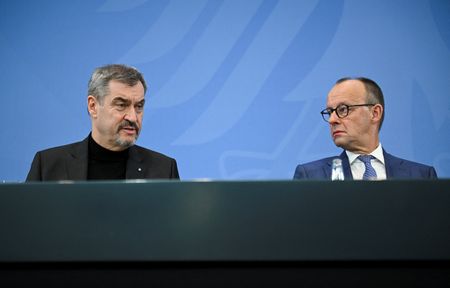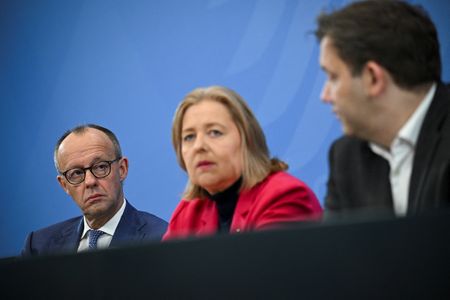

BERLIN, Dec 11 (Reuters) - Germany's ruling coalition has agreed a new law to fast-track infrastructure projects and to scrap clean-heating legislation in favour of a broader law on modernising buildings, Chancellor Friedrich Merz said on Thursday.
Merz's government, which took power seven months ago, has pledged to revive Germany's sluggish economy, Europe's largest, by accelerating projects to improve infrastructure.
The conservative chancellor said a wide range of transport schemes would be classified as being of "overriding public interest" under the new law, giving them priority in planning and approval processes.
All related administrative procedures will move to a "digital only" standard intended to shorten timelines, while electrifying rail lines of up to 60 kilometres (37 miles) will no longer require an environmental impact assessment, he said.
"Environmental protection remains important but it can no longer block urgently needed measures through endless procedures," Merz told a press conference following Wednesday evening's cabinet meeting.
Germany was long admired for the efficiency of its infrastructure but has been increasingly criticised for letting it decay due to successive governments' aversion to taking on new debt.
Breaking with that fiscal tradition, Merz's government earlier this year pushed through debt reforms to borrow hundreds of billions of euros in a special fund, though critics say some of that fiscal firepower has been used to prop up day-to-day spending.
MORE FLEXIBILITY ON TECHNOLOGY CHOICES
On heating, Merz confirmed the coalition would scrap a contested law that requires most newly installed systems to run largely on renewable energy.
The measure, pushed through by the previous centre-left government, triggered a backlash from homeowners and opposition parties and was widely seen as contributing to a sharp slump in support for the coalition that eventually collapsed.
The revamped Building Modernisation Act will keep the goal of cutting emissions from buildings but give households more flexibility over technology choices and timelines. The government plans to send it to parliament by next spring.
With five state elections looming next year, Merz's conservatives and their junior coalition partner, the centre-left Social Democrats, need some wins after a series of political blunders.
Support for both parties has dropped since February's federal election, while the far-right Alternative for Germany has shot into pole position in nationwide surveys.
(Reporting by Sarah Marsh; editing by Matthias Williams and Gareth Jones)