By Felix Light
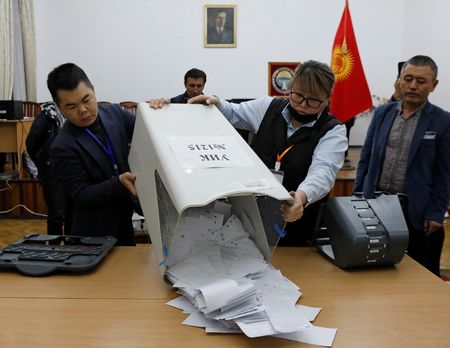
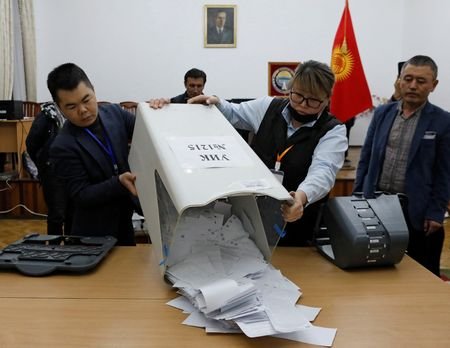
BISHKEK, Dec 1 (Reuters) - OSCE election observers said on Monday that a weekend parliamentary election in Kyrgyzstan had been efficiently run, but stifled by a restrictive campaign environment and that fundamental freedoms were increasingly limited.
Allies of President Sadyr Japarov won the vast majority of seats, cementing the power of the president, who has clamped down on media and opposition in the Central Asian country whose location and natural resources have seen Russia, the U.S. and neighbouring China all jostle for influence.
Moscow has a military air base there and exports to Russia via Kyrgyzstan have risen sharply since the West imposed sanctions on Russia after President Vladimir Putin sent tens of thousands of troops into Ukraine in 2022, boosting economic growth.
The Organisation for Security and Cooperation in Europe (OSCE) said in a statement that the weekend elections had been "efficiently run but the restrictive campaign environment stifled candidate and voter engagement."
It added: "While the fundamental freedoms are protected by the constitution, they are increasingly limited in practice."
Authorities had exercised excessive control over allowing candidates to run for office and fear of "retribution for political activity" had dampened voter interest, the OSCE said.
Kyrgyzstan since independence from the Soviet Union in 1991 had been distinguished by its lively political life in a region otherwise dominated by authoritarianism.
Kyrgyz leaders were ousted by protests against elections critics said were rigged in 2005, 2010, and 2020 and the country's media was traditionally the region's most free.
But since taking power in the 2020 protests, Japarov has signalled a break with the past, cracking down on opposition and introducing swingeing restrictions on media freedom.
In the run up to the election, Japarov ruled out future "coups" in Kyrgyzstan, and predicted that he would take more than 90% of the vote in presidential elections due in 2027.
He has largely sidelined the country's traditional political parties. The bulk of candidates in the weekend election were independents broadly loyal to him.
On Friday, Deputy Prime Minister Edil Baisalov, a Japarov ally, told Reuters that parliamentary democracy had failed in Kyrgyzstan, having delivered neither political stability nor higher living standards.
He said: "We thought that we would adopt a Westminster-style parliamentary system and that we would live like Western countries. But it did not work and it will not work."
(Reporting by Felix Light in Bishkek; Editing by Andrew Osborn)