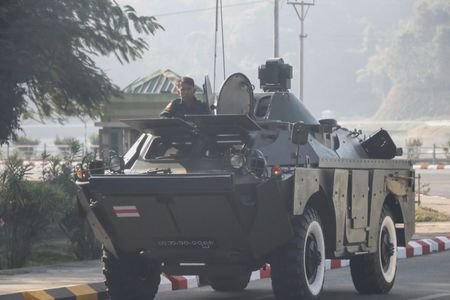
Dec 24 (Reuters) - Nearly five years after it seized power, Myanmar's military is moving ahead with a multi-phase general election starting on Sunday, despite conflict across the country.
Here is a timeline of key moments in Myanmar's recent history:
NOVEMBER 2015: Myanmar holds its second general election since the end of five decades of military rule in 2011. Nobel laureate Aung San Suu Kyi and her National League for Democracy party win by a landslide, routing the military-backed ruling Union Solidarity and Development Party.
NOVEMBER 8, 2020: Myanmar holds a nationwide election in which the NLD claims a landslide victory.
NOVEMBER 11, 2020: The main opposition, the army-backed USDP, calls for a re-run of the election, alleging irregularities.
FEBRUARY 1, 2021: As the NLD prepares to start its second term in office, Myanmar's military stages a coup, arresting Suu Kyi, President Win Myint and other senior figures from the ruling party. The military-backed Vice President Myint Swe becomes president but immediately transfers power to the military, which forms a junta to administer the country.
FEBRUARY 7, 2021: Protests sweep across Myanmar as tens of thousands of people take to the streets in Yangon and other parts of the country in the biggest demonstrations in years.
MARCH–APRIL 2021: The military violently suppresses demonstrators, prompting many protesters to take up arms against the junta, marking a shift toward a nationwide rebellion.
APRIL 2021: Remnants of Suu Kyi's party and pro-democracy activists establish a parallel civilian administration, the National Unity Government. Junta chief Min Aung Hlaing goes to Jakarta for an emergency meeting of Association of Southeast Asian Nations leaders, who agree a "five-point consensus" roadmap aimed at securing peace in Myanmar.
OCTOBER 2021: ASEAN decides to exclude Myanmar's military leadership from its summits over its failure to take steps to implement the peace plan.
DECEMBER 30, 2022: Suu Kyi is sentenced to 33 years in jail on charges ranging from electoral violations and breaching of coronavirus restrictions to corruption - allegations she denies. The sentence is later reduced to 27 years.
MARCH 2023: The military-appointed election commission dissolves the NLD and dozens of other political parties for failing to re-register under new rules.
OCTOBER 27, 2023: A collection of ethnic minority armed groups launch a coordinated offensive against the military near the Chinese border, taking over swathes of territory and posing the most significant threat to the junta since the coup.
JULY 2025: The military government enacts a controversial law aimed at protecting an upcoming election from obstruction, disruption and destruction, with penalties including the death sentence.
AUGUST 1, 2025: Myanmar forms an interim government after ending a state of emergency lasting more than four years, with Min Aung Hlaing assuming the presidency while also remaining military chief.
AUGUST 18, 2025: Myanmar announces it will hold the first phase of a multi-stage election on December 28, outlining a roadmap for the first national polls since the coup.
OCTOBER 29: Myanmar's junta announces that the second phase of the election will be on January 11, covering 100 more townships across the country.
DECEMBER 14: Junta spokeperson Zaw Min Tun fires back at international criticism of the election, saying the move has public support and is not being conducted with coercion, force or suppression.
(Compiled by Shoon Naing; Editing by Martin Petty and Raju Gopalakrishnan)