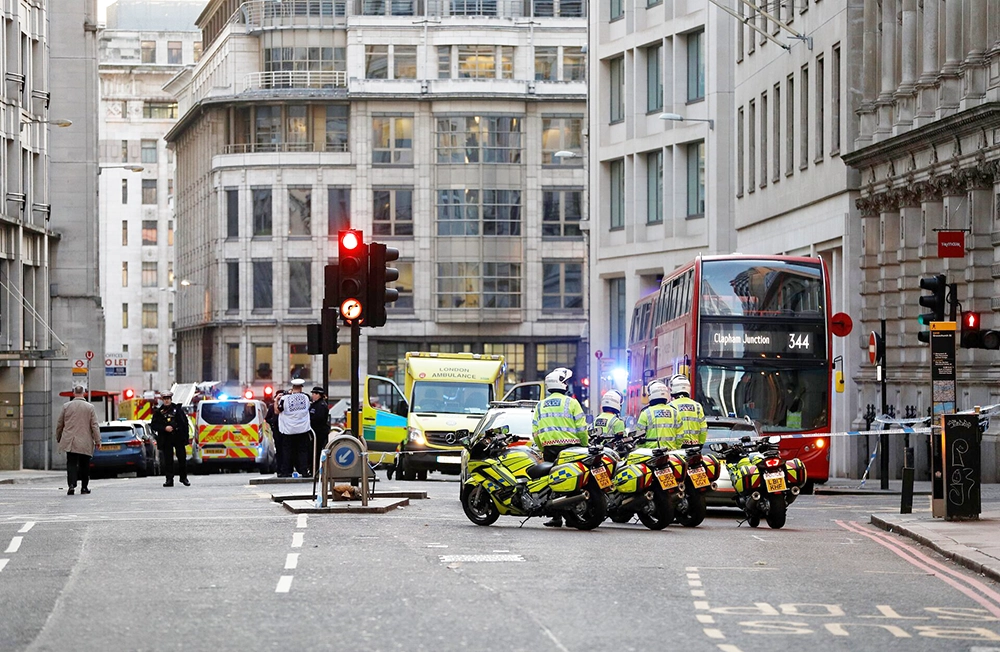
London, yet again, was rattled by a terror attack, on 29 November 2019. A 28-year-old, a terror convict and a parolee from Staffordshire, Usman Khan, unleashed a violent knife attack, killing two and injuring three people, in a bloody rampage at Fishmongers' Hall that hosted Learning Together conference, organised by University of Cambridge on the power of rehabilitation scheme.
Reportedly, Khan started the lethal attack in the basement of the Hall, after he attended the conference's morning session. Allegedly, first, he threatened to blow up the building with a fake suicide vest. Then he ran amok, attacking anyone who tried to confront him, fatally stabbing Jack Meritt, 25, and Saskia Jones, 23, Cambridge graduates, both were the coordinators of the conference.
On this otherwise a typical wintry day, the bystanders were horrified to witness Khan moving southward on the crowded London Bridge, brandishing knives in both hands. Few brave members of public tackled Khan to the ground, and others sprayed him with the fire extinguishers, while he continued to scream “get off me”. The rapid response Metropolitan police arrived within six minutes on the scene. Suspecting Khan wearing a suicide jacket and threatening to blow, the police fired a volley of bullets, in front of stunned passer-byes, killing him on the spot.
With Khan's death, everyone—the participants in the gory incident, the defenceless victims and the cops who fatally shot him—believed they had killed a dangerous criminal. What, however, they perhaps didn't realise, is that the bullets might have missed the subtle mental illness that engendered the criminal in him. And, there may be many like him, currently lodged in the UK jails.
The statistics by the Office of National Statistics (ONS) study of psychiatric morbidity (mental ill health) among prisoners indicate that approximately 90% of prisoners have a psychosis, a neurosis, a personality disorder, or a substance misuse problem. Moreover, people from Black and minority ethnic (BME) communities are found to be over-represented in English and Welsh prison populations. Statistics show males from BME communities account for 19% (approximately three times their representation in the population) in prisons nationally, and females from BME communities account for 25%. In London approximately 45% of those discharged from prison were from BME communities, London Resettlement Board statistics disclose.
The London Bridge attack has brought the nostalgia of Lee Rigby's killing with knife and blades in South London, by Michael Adebowale, a co murderer, in 2013. Adebowale had reportedly experienced psychotic symptoms before the tragic incident; it was reported at the court. “Butchered like a joint of meat” as the prosecutor revealed the gory details, made juror gasped at the Old Bailey, and the gruesomeness of this unnatural act resonated in the British society for years.
Multiple stabbing in Manchester were conducted by Mahdi Mohamud when he stabbed three people in a terror attack at Victoria railway station, on the New Years' eve of 2019. He, having been found psychiatrically unwell, serves life imprisonment in a high-security psychiatric hospital.
According to an opinion piece, in Forbes early 2019, it was reported that from 1998 to 2015, fifteen cases occurred where offenders who were convicted, had a history of mental health issues including, having been sectioned under the mental health act or hospitalised in secure mental health services.
There appears to be a correlation between terrorism and mental health, arguably a casual one. However, question arises, is it a mere chance association of mental illness with the extreme of violence seen in these cases? Or is there something more generic, innate, elusive, yet unearthed, lurking in the very fabric of these terrorists that rouses them act at such extreme levels to conduct brutal acts, without any remorse, regret or compassion for the victims?
Dr Deb Hugh, a forensic psychologist, opines that there is a high probability that Khan was suffering from severe mental illness or personality issues akin to psychopathy. Dr Pugh explains the phenomenon of psychopathy:"The lack of remorse or guilt, and callous unemotional traits are the hallmarks of psychopathy, and these terrorists appear unable to feel the pain and sufferings of others." She says, "How else would you justify a violent act that could not lead to anything but a person's death?"
There is nothing wrong in viewing the problem from the law and order's perspective, but that is equivalent to seeing the problem with blinkers off.
"It's like throwing only one shade of light in a bid to end the darkness, instead of viewing it in the entire spectrum," says Dr Pugh. Deconstructing criminal mind with the help of psychology will offer the indispensable hues which are currently missing quite conspicuously.
Far too many instances of terrorism have coalesced, indicating a peculiar pattern, stated Dr Fin Larkin, an eminent forensic psychiatrist, who has been a consultant psychiatrist at high-security Broadmoor Hospital, treating Mentally Disordered Offenders (MDO's).
He says, “Psychopathy is a development disorder that is characterised by the presence of callous, unemotional traits that renders an individual act and behave in a manner that often conflicts with social and cultural norms, without any consideration to the effects and consequences of these acts and behaviours on others."
Expanding further on this elusive category of mental disorders, he adds, "imagine, if you have a personality makeup with absolutely no moral inhibitions, no conscience whatsoever, no inhibiting thought for the welfare of family, friends or public, let alone society, something we all take for granted that others have, and then top it up with exceptional charade that you hide it from others, and to all, you appear normal".
He adds that merely reacting to a criminal's action on the spur of the moment is analogous to treating a symptom while turning a blind eye to the cause of illness. He points out the phenomenon of Lone Wolf, which has been extensively researched, especially by Mark S Hamm and Ramon Saaij.
"In my opinion, this is the key point in understanding the fifth-generation terror warfare, the acts of terrorism perpetrated by single, isolated, mostly male terrorists with extremist's ideology of all kinds that bases on racism, white supremacy, gender and religion," he says. The Lone Wolf terrorists are extremely hard to identify because not being group-based and rather quiet, they are hard to detect, he adds. "Their isolation fuels their devious and delusional thought processes like a ticking bomb and it interferes with their normal psychic functions", Dr Larkin gives his personal experience of the IRA led terror attacks, as he witnessed first-hand the horrors, while growing up as a child in Ireland.
Another psychiatrist, Dr Akmal Makhdum, who has authored several books including Malignant Unhappiness, elaborates the psychopathology of terrorism in detail. He compares many incidents of the so-called 'Muslim Terrorists' to the terrorist attacks by Non-Muslim terrorists, describing a noticeable number of these terrorists had mental illnesses. "It is time that NHS mental health services steps in, and works with the law enforcement agencies to ensure that experienced psychiatrists examine everyone suspected of terrorism, especially those who are about to be released from custody, and their dangerousness must be scientifically assessed by the forensic psychiatrists,” he says.
Khan's release from the prison has sparked a national debate on the prison correction system. There have been several pressing concerns that have come to the fore. The most important point raised is the rationale to let Khan go out of the prison, after jailed in 2012 for his role in an al-Qaida inspired plot to bomb London Stock Exchange in 2010, and conspiring to build a terrorist training camp in Pakistan.
Khan himself had admitted to preparing for terrorism including the plans to recruit UK radicals to attend a training camp in Kashmir. He was awarded an indeterminate public protection sentence (IPP). The IPP sentence is usually scrapped when the accused is believed to be not a danger to society any more. In Usman Khan's case, Lord Justice Leveson in the appeals court quashed the IPP in 2013 and replaced it with a 16-year determinate sentence.
Ideally, Khan would have had to serve at least eight years before being released. Still, strangely, he was freed on licence in less than seven years in December 2018 with a court order enforcing Khan wears an electronic tag and is placed under low-level monitoring. What worked in Khan's favour at the time of sentencing was his lawyer Joel Bennathan who argued that the accused was merely 19 at the time of the offence, and was unable to commit the crimes he was charged.
The issue drew sharp reactions from a host of political leaders including the mayor and Prime Minister Boris Johnson, who in a veiled attack at the judicial system, said that it was necessary to enforce the appropriate sentences for dangerous criminals, especially for terrorists.
Sadiq Khan, Mayor of London, also showed his concern over the scrapping of IPP sentences.
Even security minister Brandon Lewis seconded Johnson's opinion when he said, "It is right that we do have to look again at the sentences around these violent crimes."
"What can work is if we examine the young criminals first, mentally and socially, and then work on them to change their thought process consistently and rigorously. This will not incentivise to make psychology as one of the important determinants in the reformation of criminals, but will also help us build the society with more people who are mentally healthy and sound," says Sandy Mann, a mental health worker.
London terror attack is a horrible reminder, and certainly it's the opportune time to separate crime from criminals, and when we do this, we will realise that it's the menace of crime that needs to be battled ferociously. Psychological science is indeed one indispensable weapon in our armoury that can shoot the malady down without any collateral damage in the likes of Usman Khan.