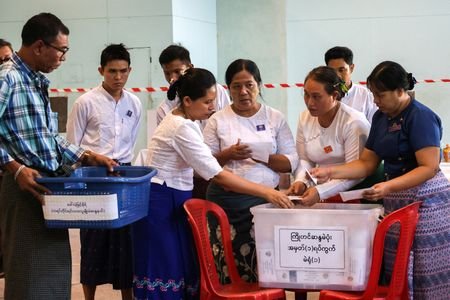
Jan 13 (Reuters) - Myanmar is holding a general election with three voting phases in what its military government says will usher in a return to civilian rule following a 2021 coup.
Following are facts and figures on elections in Myanmar:
- 4 national elections have been held in Myanmar in the past 35 years, but only two - in 2010 and 2015 - resulted in the formation of elected governments. The 2020 election was annulled by a military junta, as was a 1990 ballot - 20 years after it took place and was ignored.
- 4,863 candidates have registered for this election.
- 6 parties are taking part nationwide and 51 are vying for seats in a single region or state.
- 40 parties were dissolved in 2023 for failing to register for the election, including the former ruling National League for Democracy, whose government was ousted in 2021.
- 1,018, or one-fifth the candidates running, are from the military-backed Union Solidarity and Development Party
- 3 rounds of voting were scheduled - December 28, January 11 and January 25.
- 52.13% was the voter turnout in the first round
- 88.2% of lower house seats contested in the first round were won by the USDP.
- 265 of Myanmar's 330 townships are holding voting during the first three rounds. It is unclear when or if the rest will be contested, with a civil war raging in many areas. No dates have been set for announcing the final results.
- 664 seats are available in the bicameral parliament, with 440 in the lower house and 224 in the upper house.
- 25 percent of seats in both chambers are allocated to serving military personnel appointed by the armed forces chief, a quota set out in the 2008 constitution under Myanmar's quasi-civilian political system.
- 90 days is the period after the election when a new parliament must convene. Its members will choose speakers, then later elect a president as head of state, who then forms a government.
(Compiled by Martin Petty; Editing by Raju Gopalakrishnan and Stephen Coates)