By Devjyot Ghoshal
BANGKOK, March 19 (Reuters) - Weeks before Thailand's February general election, Anutin Charnvirakul stood at a rally in the capital Bangkok and declared that his Bhumjaithai Party should be the automatic choice for any patriotic Thai.
"I promise to you all that I will safeguard Thailand with my life," the 59-year-old prime minister said. "Just choose Bhumjaithai to guard the country, to help safeguard all of our land."
The stump speech captured Anutin's strategy of riding a wave of nationalism washing through Thailand in the wake of a fierce border conflict with Cambodia last year - a gamble that paid off.
Bhumjaithai won 191 seats in the 500-member parliament, trouncing the progressive People's Party, and then cobbled together a coalition of 16 parties - including the populist Pheu Thai - that together hold 292 seats.
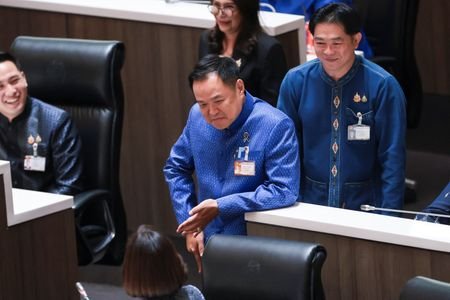
The alliance voted in parliament on Thursday to re-elect Anutin as prime minister, making him the first Thai premier to be voted back to office in two decades, underlining the political instability that has long plagued Southeast Asia's second-largest economy.
"Nationalism is in the heart of everybody in the Bhumjaithai party," he told reporters as the results trickled in last month. "Our people have given us more than what we expected."
A veteran operator, once best known for championing Thailand's legalisation of cannabis in 2022, Anutin manoeuvred into the prime minister's office with a minority government following his predecessor's ouster by a court order last August.
'RETURNING POWER TO THE PEOPLE'
Anutin's first term began six weeks after Thailand and Cambodia agreed to a ceasefire to end fierce border clashes, but the fighting resumed in early December with increased intensity, stretching the entire length of the land border between the neighbours.
The conflict afforded Anutin - a conservative staunchly loyal to Thailand's influential monarchy - an opportunity to not only burnish his nationalist credentials, but also a window to seek a decisive mandate with a parliamentary majority.
Late into the night on December 11, less than 100 days after he became prime minister, Anutin posted a short message on social media: "I am returning power to the people."
It was a move to dissolve parliament following a disagreement with the opposition People's Party that had initially supported his premiership, triggering the snap election.
HIS FATHER'S SON
Anutin was born into a family with Chinese ancestry at the intersection of money and influence - twin factors that have propelled his steady rise through the constant churn of Thai politics.
His father, Chavarat Charnvirakul, founded the Sino-Thai Engineering and Construction Company, which initially worked on projects that included fencing U.S. military sites in Thailand but eventually grew into a major construction firm.
Chavarat also entered politics, briefly serving as Thailand's acting prime minister, besides short stints in the interior and health ministries.
After an engineering degree in the United States, Anutin followed his father's path: first leading Sino-Thai, then joining politics, when he entered an administration led by billionaire Thaksin Shinawatra in 2004.
Three years later, Thaksin's populist Thai Rak Thai party was dissolved by a court order. The verdict also handed Anutin a five-year ban from politics.
MARRIAGE OF CONVENIENCE
Anutin returned to the fray in 2012 as the leader of the Bhumjaithai, then a provincial outfit with strong roots in Thailand's rural northeast, which he shaped into a national party capable of leading a coalition.
It reflects Anutin's ability to balance provincial powerbrokers, who marshal hinterland votes, and appeal to urban supporters by bringing in technocrats for key ministries, said Napon Jatusripitak of the Bangkok-based Thailand Future think-tank.
Thailand's conservative-royalist establishment, which has long wrestled with populists like Thaksin and, more recently, a younger progressive movement helmed by the People's Party, has also rallied behind Anutin, he added.
"I think many can see that, strategically speaking, Bhumjaithai is the best chance to fend off the progressives and the Thaksin-ites," said Napon. "It's definitely a marriage of convenience."
Anutin won't have much of a honeymoon.
Thailand's economy is in the doldrums, buffeted by trade tensions and tightening energy markets in the wake of the Iran conflict, besides being weighed down by soaring household debt.
Its neighbourhood is in flux, with relations with Cambodia on edge and civil war raging on in Myanmar.
And no democratically elected Thai prime minister has completed a full term since Thaksin in 2005.
(Additional reporting by Panu Wongcha-um; Editing by Raju Gopalakrishnan and Lincoln Feast.)