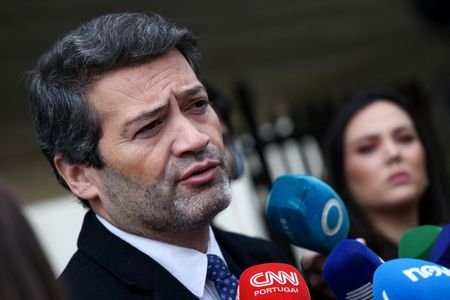
By Sergio Goncalves and Michael Francis Gore
LISBON, Feb 9 (Reuters) - The moderate Socialist candidate's decisive victory in Portugal's presidential election on Sunday showed that two-thirds of the electorate, including many conservative voters, united against his far-right rival, who likely topped out his support at 33%, according to analysts.
Still, the gains made by Andre Ventura compared to the first round last month and a general election in 2025 put his anti-establishment, anti-immigration Chega party within striking distance of becoming the largest parliamentary faction in the next general election, which is not due until 2029 unless an early vote is called. Chega currently has the second-largest number of seats in parliament.
The fact that prominent conservative figures backed Socialist Antonio Jose Seguro in the presidential runoff - a rare occurrence in Europe - could galvanize a potential centrist alliance to keep Chega away from power in the future, said Javier Carbonell, an analyst at the European Policy Centre think-tank.
A parliamentary election would also not be reduced to just two rivals, likely diluting Ventura's current support.
The Chega leader claimed that the result means he is now the leader of Portugal's right.
"We did not win, but are on the path to this victory," he told supporters on Sunday night.
But political analysts said that despite Chega's clearly growing clout and "normalisation" of the far right among voters, Ventura had clearly been unable to capture a majority of centre-right votes.
"I sincerely don't believe that Chega may rise much more than to a third of the electorate, which is the threshold that he has attained in this election," said Jose Tomaz Castello Branco, a political scientist at Catholic University in Lisbon.
"I don't buy into that idea that he is now claiming ... to lead the right wing in Portugal," he said, while acknowledging that "voters are beginning to lose their shyness about voting for a far-right party".
CHEGA IS MAIN OPPOSITION PARTY IN PARLIAMENT
Seguro, who promised to "unite the country" and build political bridges in a highly fragmented parliament, won nearly 3.5 million votes, or 66.8% of the total, more than doubling his result in the first round of voting on January 18.
Ventura, who campaigned to "end 50 years of corruption" by Portugal's mainstream parties, received 33.2%, or more than 1.7 million votes, about 413,000 more than in the first round.
That result was also roughly 300,000 more votes than Chega garnered in the parliamentary election last May, when it became the main opposition faction. The ruling centre-right alliance won about 2 million votes.
In the streets of Lisbon, some shared the view that Chega's sharp rise since its creation just seven years ago may have ceased.
"Perhaps we can say that we are more reassured that the far-right will not have much chance of growing further in Portugal," said Jorge Ferreira, 66.
But Matilde Ribeiro, 24, said "it's immensely worrying that the far-right candidate has risen so quickly in successive elections".
"It is a sign of what is happening in Europe and the world," she said.
(Reporting by Sergio Goncalves and Michael Gore; editing by Andrei Khalip and Paul Simao)

