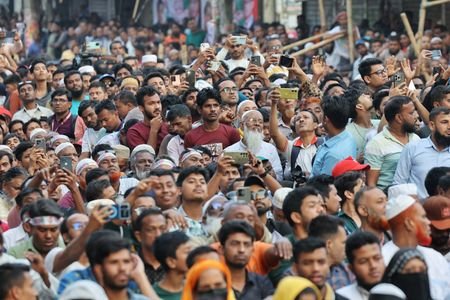
DHAKA, Feb 12 (Reuters) - Bangladeshis head to the polls on Thursday, with nearly 128 million people eligible to vote, in a key test of the country’s return to democracy after a popular uprising toppled long‑time leader Sheikh Hasina in August 2024.
Here are the main election issues in the nation of 175 million, which has been governed by an unelected interim administration since Hasina’s chaotic fall.
CORRUPTION
A recent opinion poll by the Dhaka-based Communication Research Foundation and Bangladesh Elections and Public Opinion Studies found corruption to be voters’ top concern. Bangladesh has long ranked among the world’s worst performers in Transparency International’s Corruption Perceptions Index.
Both the frontrunning Bangladesh Nationalist Party (BNP) and its main rival Jamaat‑e‑Islami have made tackling graft central to their campaigns, with Jamaat’s anti‑corruption image helping fuel its resurgence.
INFLATION
Inflation edged up to 8.58% in January, according to official data, and more than two‑thirds of respondents in the poll cited “prices” as their second‑biggest concern.
ECONOMIC DEVELOPMENT
Once one of Asia’s fastest‑growing economies, Bangladesh has struggled to regain momentum since the COVID‑19 pandemic paralysed its export‑driven garments sector. The 2024 protests against then Prime Minister Sheikh Hasina, which eventually saw her toppled and flee into exile, further disrupted the sector and weighed on overall growth.
Voters ranked economic development as their third‑highest concern.
EMPLOYMENT
With an estimated 40% of Bangladeshis under 30, the next government faces intense pressure to create jobs for millions of young people after months of instability.
BAN ON HASINA'S AWAMI LEAGUE PARTY
Hasina's Awami League has been barred from the election and she has said her party's absence would leave millions of supporters without a candidate and push many to boycott the election.
Some Bangladeshis have indeed vowed to stay away from polling booths, but analysts do not expect a mass boycott and say former Awami League voters would shape the outcome of the election.
A recent survey of various voters found that nearly half of former Awami League voters now prefer the BNP, the frontrunner in most opinion polls, followed by roughly 30% who favour Jamaat.
(Reporting by Krishna N. Das in Dhaka; Editing by Michael Perry)