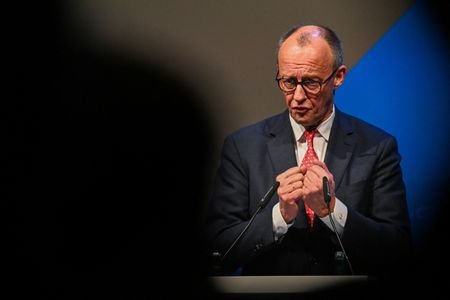
BERLIN, Feb 18 (Reuters) - Chancellor Friedrich Merz backed growing calls in Germany for controls on access to social media platforms by children, saying he had become increasingly persuaded of the need for compulsory limits by evidence of the harm done by the deliberate spreading of fake news and other forms of online manipulation.
"Do we want to allow artificially generated false news, fake news, artificially generated films and misrepresentations to be spread via social media?" he said in a speech ahead of his conservative Christian Union's annual party conference. "Do we want to allow our society to be undermined in this way, both internally and externally, and our young people and children to be endangered in this way?" he said, noting that 14-year-olds spent an average of five and a half hours a day online.
The CDU party conference on Friday is due to debate a motion calling for a ban on allowing access to platforms like TikTok or Instagram for children under the age of 16 and similar calls have been made by Merz's centre-left Social Democrat coalition partners.
A growing number of countries in Europe, including Spain, Greece, France and Britain are looking at similar social media bans or restrictions, following the example of Australia, which last year became the first country in the world to force platforms to cut off access for children.
"Two years ago, I would probably have said something different on this subject, but I completely underestimated, as we all probably did, the significance of algorithms, artificial intelligence, and targeted and controlled influence. From within, and also and especially from outside," he said.
He dismissed arguments that, instead of controls, young people should be introduced to social media slowly, saying it was equivalent to arguing that six-year-olds should be taught to drink alcohol.
Merz's support for the pressure coming from both parties in the coalition makes it increasingly likely that the federal government will push for restrictions. However, under Germany's federal system, media regulation is a state‑level responsibility and the states must negotiate with each other to agree consistent nationwide rules.
There has been growing discussion of the potential negative effects of social media on children in Germany, and the government last year appointed a special commission to look into protecting young people from potential harm online. That commission is expected to report later this year.
(Reporting by James Mackenzie; Editing by Daniel Wallis)