By Pavel Polityuk and Yuliia Dysa
KYIV, Feb 19 (Reuters) - Russian airstrikes on Ukraine's Black Sea ports late last year have reduced their capacity and harmed Ukrainian agricultural and mineral exports, industry sources said, the country's main source of income during its four-year war with Russia.
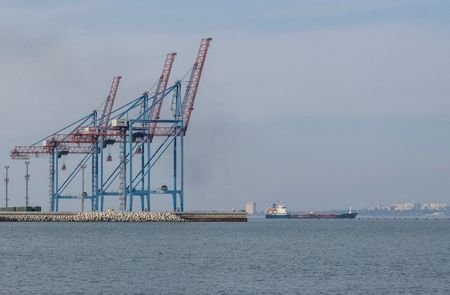
The Odesa region of southern Ukraine - home to a large shipping hub with terminals in the ports of Odesa, Chornomorsk, and Pivdennyi - has been targeted since the early days of Russia's full-scale invasion in 2022.
However, Ukraine, which ships about 90% of all its exports via that shipping hub, has managed to operate its own "maritime corridor", with vessels hugging the coast and keeping away Russia's fleet with naval drones.
But Russia sharply increased the intensity of attacks on the Black Sea ports in December when President Vladimir Putin threatened to "cut Ukraine off from the sea".
An industry source said Russian strikes damaged 13 civilian vessels in December, mostly bulk cargo, commonly used for transporting grain and iron ore, Ukraine's biggest exports.
That represented nearly 10% of all vessels hit since the war started four years ago, Reuters calculations show.
EXPORT CAPACITY TARGETED
A source in the transport industry, who asked for anonymity due to the sensitivity of the issue, told Reuters that strikes on the Odesa ports in the last few months had reduced their export capacity by up to 30% from their pre-war level.
So far, the decline in ports' capacity has not curbed overall export levels, as shipment volumes are significantly lower than pre-war levels due to the impact of the conflict on production, the source said.
However, the attacks on port infrastructure - causing a jump in logistics and freight costs - hurt local businesses, forcing them to lower their prices to remain competitive on the global market, the producers and a business lobby said.
Constant power outages caused by Russian attacks on Ukraine's energy sector further exacerbate the situation, in some cases making production unprofitable, they said.
The airstrikes meant that ports were only able to ship around three-quarters of planned exports in December, data seen by Reuters showed. That recovered to 84% in January when the intensity of strikes declined.
"In the Odesa region alone, air raid alerts were activated more than 800 times (in 2025), and the total downtime amounted to more than one month of port operations," Ukraine's Maritime Ports Administration said in a statement.
ORE EXPORTS DROP, GRAIN LESS AFFECTED
Agricultural products account for over 50% of Ukraine's total export revenues, Deputy Economy Minister Taras Vysotskiy said, amounting to nearly $23 billion last year.
Officials said the overall volume of farm exports dropped last year mostly due to a smaller grain harvest and delays in corn harvesting caused by unfavourable weather.
But attacks on infrastructure disrupted the timing of exports.
Economy ministry data show that Ukraine exported 4 million tons of agricultural goods in November. In December, at the peak of Russia's attacks, they fell to 3.7 million tons and remained at the same level in January.
Svitlana Lytvyn, analyst for the Ukrainian Agribusiness Club (UCAB) lobby group, said "the suspension of port operations during shelling or even air raid alerts... significantly delays shipments".
In February, when attacks on the ports decreased, Ukraine's agricultural exports rose, the state-owned rail company Ukrzaliznytsia said. Shipments to the ports grew by 7% in the first 17 days of February versus the same period in January, to reach about 1.4 million tons, rail data shows.
Ukraine's second-largest export item is iron ore, most of which is shipped to China.
Analysts at GMK Center said ore exports fell by 8.7% in November from the previous month, remained stable in December, and fell again by 7.5% in January.
Higher logistics costs in Ukraine, combined with a decline in iron ore prices in China, accounted for the drop, it said.
Since late 2025, Russia has also escalated attacks on railway infrastructure. Infrastructure Minister Oleksiy Kuleba said Russia had launched 266 strikes on trains and railway facilities so far in 2026.
"Damage to railways, frequent power outages on sections of the network, suspension of trains and forced use of diesel locomotives instead of electric ones - all of this significantly increases delivery times to the ports and transportation costs," the ministry statement said.
(Reporting by Pavel Polityuk and Yuliia Dysa; Editing by Daniel Flynn and Gareth Jones)