By David Brunnstrom and Emma Farge
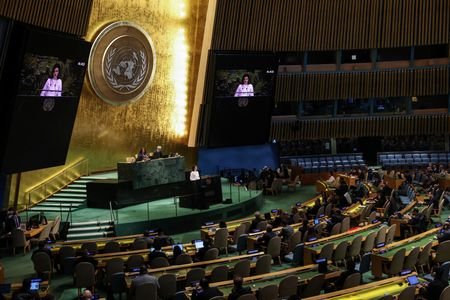
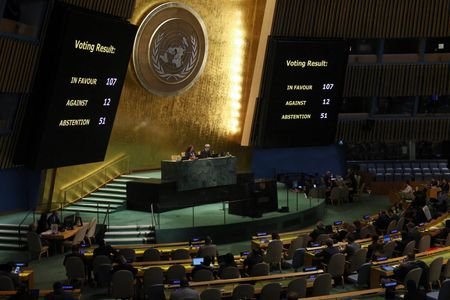
WASHINGTON/GENEVA, Feb 24 (Reuters) - The U.N. General Assembly adopted by a wide margin on Tuesday a resolution supporting Ukraine, backing its international borders and voicing concern over intensifying Russian attacks on civilians and critical energy infrastructure.
The vote by the assembly, which has repeatedly supported Ukraine, passed with 107 in favour, 12 against, and 51 abstentions.
The resolution, which is not legally binding but carries political weight, was seen as a test of solidarity with Ukraine on the fourth anniversary of Russia's invasion. A breakdown of voting showed that Russia, Belarus and Sudan were among the opponents while China and the United States abstained.
Tammy Bruce, the U.S. deputy U.N. envoy, explained the U.S. abstention, saying that while Washington welcomed the call for an immediate ceasefire, the resolution included language likely to distract from ongoing negotiations, "rather than support discussion of the full range of diplomatic avenues that may pave the way to that durable peace."
The 15-member U.N. Security Council has been deadlocked throughout the war and unable to take action on Ukraine because Russia holds a veto.
In a statement to a later Security Council meeting on Ukraine, U.N. Secretary-General Antonio Guterres said the war remained "a stain on our collective conscience" and reiterated calls for an immediate ceasefire.
The council session saw a clash between the U.S. and China over Washington's charge that Beijing's imports of Russian oil and Chinese sales of materials with military uses to Russia have helped sustain Moscow's operations in Ukraine.
"China remains a decisive enabler of Russia's war machine," Bruce told the council. "If China truly wants peace, it should immediately end exports of dual-use goods and stop purchasing Russian oil."
Fu Cong, China's U.N. ambassador, responded by accusing the U.S. of fabricating "all sorts of excuses and lies" about China intended "to create division and conflict." Washington, he said, should "stop shifting blame and creating conflicts and wars around the world."
Russia's U.N. ambassador, Vasily Nebenzya, said Europe was presenting itself as the source of moral standards for others when it brought a "brutal regime of a neo-Nazi ilk" to power in Ukraine. He called the general assembly resolution "another manipulation" that had "nothing to do with reality."
Russia has given various reasons for sending troops into its neighbour, including needing to "demilitarise" Ukraine and respond to the U.S.-led NATO alliance's eastward expansion in the years since the Soviet Union collapsed.
Kyiv and its Western allies deny posing a threat to Russia, which they accuse of staging a land-grab.
Ukrainian President Volodymyr Zelenskiy has urged allies to maintain their support as divisions among European partners over a fresh package of sanctions against Moscow overshadowed commemorations of the start of the conflict.
In another sign of support at the United Nations, dozens of countries including France, Britain, Canada, Japan and Peru gathered to condemn Russia's violations at a meeting on the sidelines of the Human Rights Council in Geneva.
"What Russia has done and is doing in Ukraine right now is violating every principle in the book," Espen Barth Eide, Norway's foreign minister, told the meeting.
"Everything the U.N. stands for is being violated," he added, ending his speech with "Glory to Ukraine!"
A group of mostly European diplomats also walked out of a meeting of the Conference on Disarmament during a speech by Russian ambassador Gennady Gatilov in Geneva. They gathered outside, holding the Ukrainian flag and wearing sashes in the national colours.
(Reporting by Emma Farge, Cecile Mantovani, David Brunnstrom and Jonathan Landay; Editing by Friederike Heine, Kevin Liffey, Alexandra Hudson, Andrea Ricci and Nia Williams)