By Andreas Rinke, Liz Lee and Colleen Howe
BEIJING, Feb 25 (Reuters) - German Chancellor Friedrich Merz called for partnership and dialogue with China on a visit to Beijing aimed at resetting relations that have been clouded by a yawning trade deficit with the world's second-largest economy.
On his first visit to China as chancellor, Merz, who was accompanied by a large business delegation, told President Xi Jinping that he wanted to deepen what he called the "comprehensive strategic partnership" with China, Germany's largest trading partner last year.
Xi welcomed the comments from Merz, who faces a tough balancing act of redefining an economic relationship that has been increasingly unfavourable to Germany, but which remains central to its core industrial interests.
"The more turbulent and intertwined the world becomes, the more China and Germany need to strengthen strategic communication and enhance strategic mutual trust," he said.
The German chancellor's visit, following visits by French President Emmanuel Macron and British Prime Minister Keir Starmer, came as European leaders have looked to shore up their relationships with China following the widening rift with the Trump administration in Washington.
It underlined the vital importance of China's huge consumer market and the technical sophistication of its all-conquering manufacturers for Germany's weakened economy, still emerging from two years of recession.
But it came against a background of gathering unease by German business, which has been increasingly concerned with "derisking" strategies aimed at reducing strategic dependence.
Merz, who is due to visit Washington next week, encouraged Chinese firms to step up investments in Germany but said both sides needed to remain clear-eyed.
"Today, we are closely connected. This opens up opportunities, but it also presents risks," he said. "We want to avoid these risks in the interests of both sides," he said, pointing to supply chain problems for German manufacturers laid bare last year when China tightened export controls on basic chips and vital rare earths.
The comments reflect longstanding German concerns about what Berlin sees as an undervalued yuan, market-distorting subsidies and overcapacity among Chinese exporters that have built massive trade surpluses with Europe's largest economy, amounting to 90 billion euros ($106 billion) last year.
Merz noted that the trade deficit had increased fourfold since 2020, and said this was largely due to overcapacity. "This dynamic is not healthy," he told reporters after the meetings.
"NEW IMPETUS"
However, a joint statement issued on the Xinhua news agency said the visit had "injected new impetus into the development of the partnership" and Merz said China had ordered 120 aircraft from European aircraft maker Airbus.
"Both sides are willing to properly resolve their respective concerns through frank and open dialogue," the statement said.
Premier Li Qiang told Merz that China wished to cooperate in areas like automobiles and chemicals as well as emerging fields including artificial intelligence and biomedicine.
He said China would "actively address the reasonable demands of foreign-invested enterprises from Germany," and said China was willing to import more high-quality products from Germany, according to a readout from the meeting on Xinhua. He also encouraged Chinese companies to invest in Germany.
Merz was accompanied by top executives from 30 German firms including top carmakers such as Volkswagen and BMW which are acutely feeling the strain of Chinese competition - contributing to the growing trade imbalance.
China has been seeking to present itself as a reliable economic partner, as Europe struggles with a new, less-certain relationship with Washington and the vulnerabilities in its supply chains exposed last year.
China's market, once coveted by foreign businesses for its wide consumer base and rising spending power, has changed in recent years with a slowing economy capping consumer demand and manufacturing overcapacity increasingly pushing domestic firms to look for opportunities abroad.
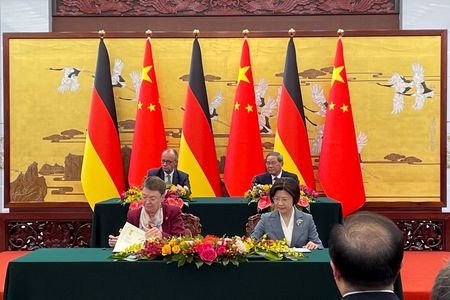
The agreements Merz and Li formalised after their meeting were narrowly targeted and in industries peripheral to both economies.
The five documents signed covered continued efforts in climate change and green transition, cooperation in animal disease prevention and a poultry products protocol, as well as sports collaboration agreements for football and table tennis.
That paled in comparison with Canada and Britain, which respectively signed eight and 12 documents with China last month during visits by Canadian Prime Minister Mark Carney and Britain's Starmer.
($1 = 0.8488 euros)
(Additional reporting by Colleen Howe, Xiuhao Chen, Yukun Zhang in Beijing; Writing by James Mackenzie; Editing by Michael Perry, Kim Coghill, Alexandra Hudson and Andrea Ricci )