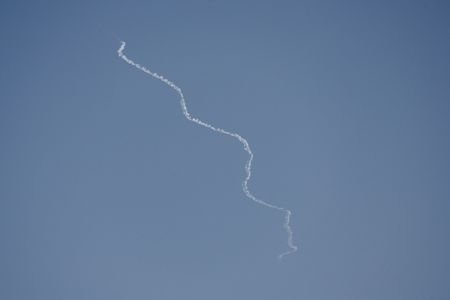
JERUSALEM, February 27 (Reuters) - Israel has multi-layered air defences against Iranian ballistic missiles, an umbrella it may need to lean on as the United States and Iran teeter toward potential military conflict that could draw Iranian attacks on Israeli territory.
ARROW
The long-range Arrow-2 and Arrow-3 interceptors, developed by Israel with an Iranian missile threat in mind, are designed to engage incoming targets both in and outside the atmosphere respectively. They operate at an altitude that allows for safe dispersal of any non-conventional warheads.
State-owned Israel Aerospace Industries is the project's main contractor while Boeing is involved in producing the interceptors.
DAVID'S SLING
The mid-range David's Sling system is designed to shoot down ballistic missiles fired from 100 km to 200 km (62-124 miles) away.
Developed and manufactured jointly by Israel's state-owned Rafael Advanced Defense Systems and RTX Corp, a U.S. company previously known as Raytheon, David's Sling is also designed to intercept aircraft, drones and cruise missiles.
IRON DOME
The short-range Iron Dome air defence system was built to intercept the kind of rockets fired by Palestinian Islamist militant group Hamas in Gaza.
Developed with U.S. backing, it became operational in 2011. Each truck-towed unit fires radar-guided missiles to blow up short-range threats such as rockets, mortars and drones in mid-air.
A naval version of the Iron Dome, to protect ships and sea-based assets, was deployed in 2017.
The system determines whether a rocket is on course to hit a populated area. If not, the rocket is ignored and allowed to land harmlessly.
Iron Dome was originally billed as providing city coverage against rockets with ranges of between 4 km and 70 km (2.5-43 miles), but experts say this has since been expanded.
IRON BEAM
Developed by Israel for more than a decade and declared fully operational in late 2025, the ground-based, high-power Iron Beam laser system is designed to intercept smaller aerial threats, such as UAVs and mortars. Using lasers to super-heat and disable aerial threats, Iron Beam's operation is expected to be substantially cheaper than some of the other aerial defence systems that use intercepting missiles to shoot down incoming threats.
U.S. THAAD SYSTEM
The U.S. military said in October 2024 that it had sent the advanced anti-missile system THAAD - Terminal High Altitude Area Defense - to Israel.
THAAD is a critical part of the U.S. military's air defences and is designed to intercept and destroy short, medium and intermediate-range ballistic missile threats in their terminal phase of flight.
The U.S. military helped to shoot down Iranian missiles fired at Israel, using ground-based systems, one U.S. official said in June 2025, after Israel attacked Iranian nuclear facilities. A U.S. Navy destroyer in the Eastern Mediterranean also helped to shoot down incoming ballistic missiles, Israeli media has reported.
AIR-TO-AIR DEFENCE
Israeli combat helicopters and fighter jets have fired air-to-air missiles to destroy drones that were heading to Israel, military officials have said.
(Reporting by Maayan Lubell and Rami Ayyub; editing by Philippa Fletcher)

