By Max Hunder
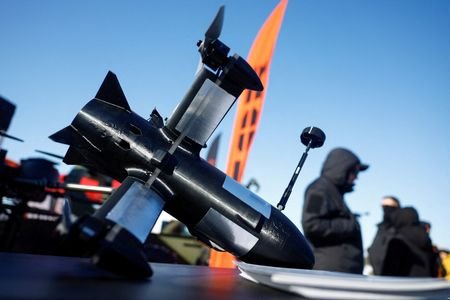
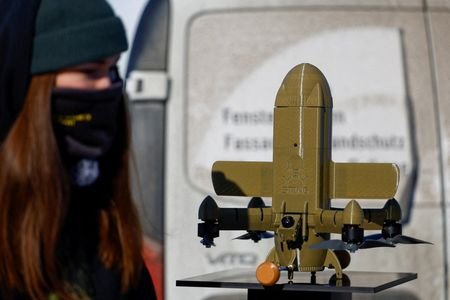
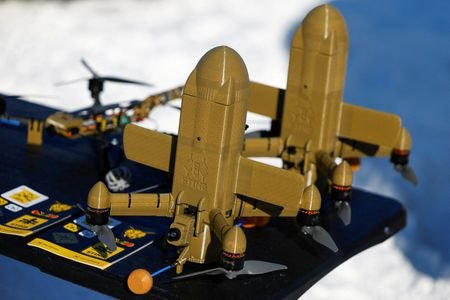
KYIV, March 5 (Reuters) - The U.S. and Qatar are in discussions with Kyiv about acquiring Ukrainian interceptor drones as a cheap alternative to down Iranian Shahed UAVs amid the war in the Gulf, a source familiar with the matter told Reuters.
The early-stage talks are taking place between government officials, not companies, and the technology being discussed includes systems to listen out for incoming enemy drones and disrupt their communication signals, the source said.
Qatar's International Media Office did not respond to a request for comment. The Pentagon declined to comment.
KYIV HAD DISCUSSED SWAPPING DRONES FOR MISSILES
Ukrainian President Volodymyr Zelenskiy said on Thursday evening the United States had asked Kyiv for help in downing Shaheds.
"I have instructed that the necessary resources be provided and that Ukrainian specialists be present to ensure the necessary security," he said, without giving further details or mentioning Ukrainian interceptor drones.
Zelenskiy said earlier that Ukraine had also received similar requests from Middle Eastern countries and that he would only go ahead with deals if they did not weaken Ukraine's own defences against Russia's invasion.
He has also said he would be open to exchanging drones for air defence missiles.
A second source - a Western diplomat in the Gulf - said a Ukrainian delegation had travelled to Doha this week to meet with Qatari officials to share Ukraine's experience in drone defence. A delegation also travelled to Abu Dhabi, the diplomat said.
Tehran has fired hundreds of missiles and drones at Gulf countries after the U.S. and Israel launched a massive campaign of air strikes at Iran on Saturday and killed much of the Islamic Republic's senior leadership.
Gulf countries have managed to intercept most of those strikes, making use of the U.S.-made PAC-3 Patriot systems that Ukraine relies on to defend its own energy and military infrastructure from Russian missiles.
Ukraine, however, has developed far cheaper methods of downing the Shahed kamikaze drone during its four-year conflict with Russia, which has been using the Iranian-designed UAVs for much of the war.
Russia has launched 19,000 long-range drones at Ukraine this winter, most of which it has downed, Kyiv said.
After the Iran war erupted, Ukraine's SBU security service warned Ukrainian companies not to sell weapons to Middle Eastern countries without permission from Kyiv, the first source said.
The SBU and Ukraine's defence ministry did not respond to requests for comment.
A third source said Britain was supporting Ukraine in early-stage talks with Gulf states about the use of Ukrainian drones to intercept Shaheds.
That source said some drones could potentially be supplied by Project Octopus, an existing interceptor drone joint venture between London and Kyiv.
Britain's Ministry of Defence did not respond to questions. Ukrspecsystems, the Ukrainian company behind the Octopus drone factory in the UK, declined to comment.
US, ALLIES HAVE USED HUNDREDS OF DEFENCE MISSILES
Zelenskiy said on Wednesday he had spoken with leaders of the UAE, Qatar, Bahrain, Jordan and Kuwait, without providing details.
Ukraine's discussions with Washington were first reported by the Financial Times, but Doha's interest and Britain's involvement have not previously been reported.
The U.S. and its Gulf allies have expended hundreds of air defence missiles, costing millions of dollars apiece, since the Iran conflict began.
Lockheed Martin produces around 600 PAC-3 missiles a year, although it plans to increase that to 2,000 under a seven-year deal with the Pentagon.
Kyiv has been running low on those missiles for months, raising concerns that it would be unable to down Russian ballistic missiles, against which the Patriot is the only effective weapon in its arsenal.
Zelenskiy has proposed swapping Ukrainian interceptor drones for missiles for Patriot systems.
Taras Tymochko from Come Back Alive, a Ukrainian foundation that has bought tens of thousands of interceptor drones with donations, said it was unclear who, other than Ukrainian crews, could operate them.
"It's rather difficult to remove our pilots from their operations and send them to the Middle East," Tymochko said. "There's a significant need to scale up existing training capacities in Ukraine to share experience with our partners."
(Reporting by Max Hunder; additional reporting by Alexander Cornwell in Tel Aviv, Andrew Mills in Doha and Idrees Ali in Washington; Editing by Daniel Flynn and Andrew Heavens)