By Abdelaziz Boumzar, Steven Scheer and Alexander Cornwell
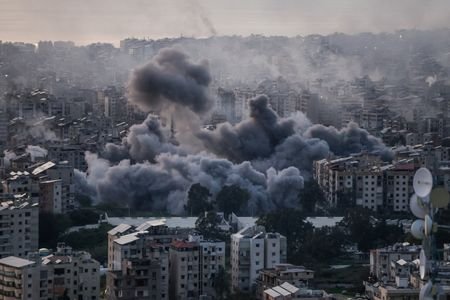
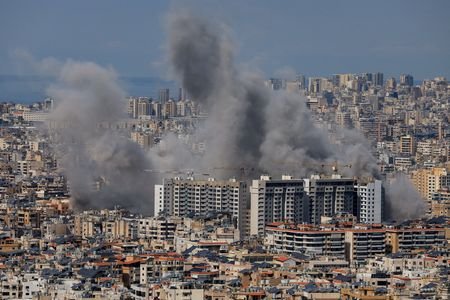
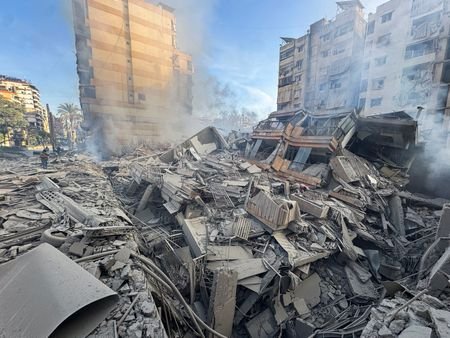
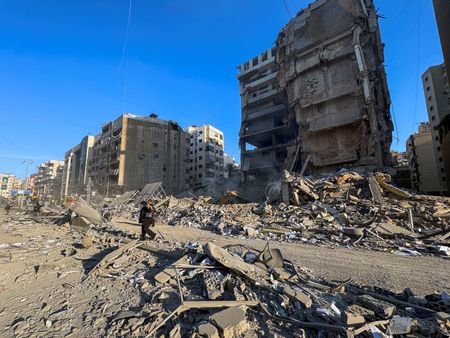
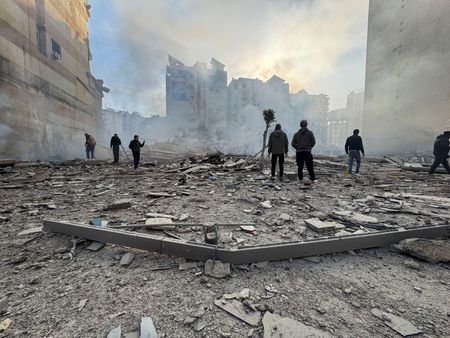
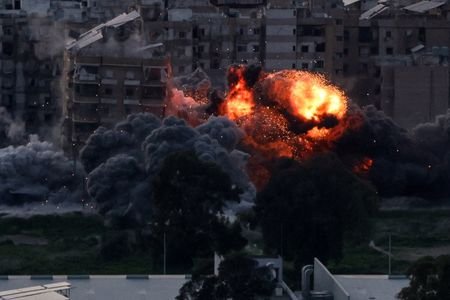
BEIRUT/JERUSALEM, March 6 (Reuters) - Israel pounded Beirut's southern suburbs with airstrikes on Friday, stepping up a war with Hezbollah that has forced hundreds of thousands of Lebanese from their homes and killed more than 200, according to a health ministry toll.
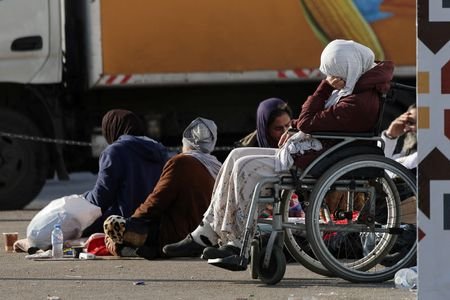
Israel ordered everyone in the densely-populated suburbs, Hezbollah's main stronghold in the capital, to leave on Thursday before launching strikes that lit up the night sky. It has also warned civilians to quit swathes of southern and eastern Lebanon - heartlands of the Lebanese armed Shi'ite Muslim group.
They were the widest evacuation orders ever given by Israel in Lebanon and prompted a huge displacement of people before the bombardments that continued into Friday, sending columns of smoke billowing across the Beirut skyline.
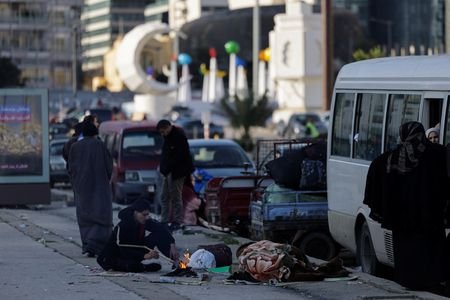
"We’re sleeping here in the streets - some in cars, some on the street, some on the beach," said Jamal Seifeddin, 43, who spent the night outside in the capital's downtown district.
"I've never slept on the ground like this. I've been forced to. No one even brought a blanket," he said.
The Norwegian Refugee Council estimated that 300,000 people had been displaced in Lebanon, with the number of people who could be displaced potentially exceeding one million.
FIGHTING IN THE SOUTH
Lebanon was pulled into the war in the Middle East on Monday, when Hezbollah fired rockets at Israel that ignited a new Israeli offensive against the group - established by Iran's Revolutionary Guards in 1982 - 15 months after their 2024 war.
The Lebanese Health Ministry reported a sharp increase in the death toll during the day, to 217 killed since Monday from 127 earlier, and said another 798 had been wounded. Its figures do not distinguish between fighters and civilians.
No fatalities have been reported in Israel as a result of Hezbollah attacks. The Israeli military said eight Israeli soldiers were injured - five of them seriously - by projectile fire toward Israeli territory near the border.
Defence Minister Israel Katz earlier said Finance Minister Bezalel Smotrich's son, a combat soldier, had been injured in Lebanon.
Katz said in a statement that Israeli soldiers had significantly expanded five positions held in Lebanon since November 2024, and were advancing, suggesting the aim was to create a buffer to protect Israeli communities near the Lebanese border.
Reuters footage showed an Israeli armoured vehicle in the town of Khiyam in southern Lebanon, as the sound of heavy gunfire could be heard.
Hezbollah said it was fighting an Israeli ground incursion there, targeting a gathering of military vehicles near Khiyam.
Israeli attacks on Hezbollah will likely continue even if the war with Iran were to end, a source briefed on Israel's military strategy has told Reuters.
Another, Lebanese, security source said: "This is about ending Hezbollah once and for all", raising the prospect of a longer conflict in the country, where Hezbollah, while diminished, remains a powerful force.
ISRAEL SAYS IT TARGETS HEZBOLLAH FACILITIES
An Israeli military official said several waves of strikes were launched against Hezbollah in the southern suburbs, striking about 115 targets including in residential buildings that the official said the group used as headquarters.
Airstrikes have also targeted Tripoli in the north of Lebanon, Tyre, Sidon and Nabatieh in the south, and Baalbek in the east, the official said.
Israeli military spokesperson Nadav Shoshani said Hezbollah had fired hundreds of rockets and drones at Israel this week, including around 70 rockets since midnight on Friday.
Imran Riza, U.N. Humanitarian Coordinator in Lebanon, told Reuters that around 100,000 people had already been displaced into shelters in Lebanon, and the number of displaced was expected to rise dramatically.
"What we saw in the last couple of days is, I would say ... unprecedented in terms of the scale here in Lebanon of the warnings, the displacement orders, and the reaction, the panic also, that this has all created," Riza said.
The U.N. human rights chief Volker Turk criticised Israel's evacuation orders, saying they raised serious concern under international humanitarian law.
More than 1 million people were displaced in Lebanon during the 2024 conflict.
Hezbollah was badly weakened by Israel during the 2024 war and has been under pressure since then to disarm.
HEZBOLLAH TELLS ISRAELIS TO FLEE THEIR HOMES
Hezbollah, in a message published in Hebrew on its Telegram channel early on Friday, warned Israelis to leave towns within 5 km (3 miles) of the border.
"Your military's aggression against Lebanese sovereignty and safe citizens, the destruction of civilian infrastructure and the expulsion campaign it is carrying out will not go unchallenged," Hezbollah said.
During fighting between Hezbollah and Israel in 2024, tens of thousands of Israelis were evacuated from towns in the border area but many have since returned. Israeli officials have previously said there are no plans to remove them for now.
(Reporting by Abdelaziz Boumzar and Khalil Ashawi in Beirut; Steven Scheer, Maayan Lubell and Pesha Magid in Jerusalem; Hatem Maher and Nayera Abdallah, Yomna Ehab in Cairo; Jana Choukeir and Tala Ramadan in Dubai; Writing by Tom Perry and Angus McDowall; Editing by Michael Perry, Philippa Fletcher and Andrei Khalip)