By Rodrigo Campos
NEW YORK, March 10 (Reuters) - President Javier Milei aimed to persuade investors in New York on Tuesday that Argentina's economic turnaround can stay on track even as war in Iran spooks markets, saying the central bank will soon be awash with dollars.
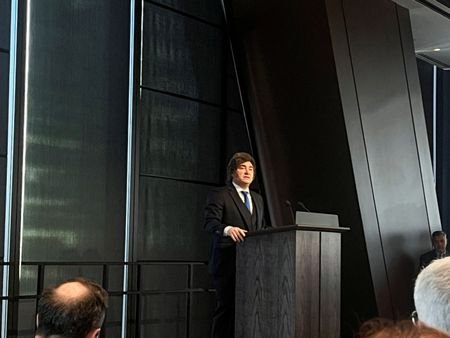
Milei spoke to investors and executives at JPMorgan's new headquarters in Midtown Manhattan as part of "Argentina Week," a New York roadshow to convince financiers that the South American country's stabilization effort remains an attractive investment story despite the tense global backdrop.
“We went from being net energy importers to net exporters in the face of what I assume is a temporary shock to what's happening in the world,” Milei said. “Our external accounts will benefit from the temporary change in the terms of trade.”
"Be ready, Santiago," he added, looking over at central bank chief Santiago Bausili. "You're going to have dollars coming out of your ears."
U.S. government backing has become a key part of Milei's pitch to investors. President Donald Trump's administration publicly supported Milei ahead of Argentina's October 2025 midterm elections and expanded financial cooperation with Buenos Aires. A liquidity facility championed by the United States helped avoid a run on the peso ahead of that vote.
The United States and Argentina deepened economic ties in February, when they signed a reciprocal trade and investment agreement designed to facilitate U.S. investment, including in the critical minerals sector.
The closer alignment with the United States marks a shift after years in which China expanded its economic footprint across South America. China remains one of Argentina's largest trading partners and a major creditor.
Oil prices are up nearly 30% this month to near $90 per barrel due to the U.S.-Israeli war with Iran, while a flight to safety has strengthened the dollar and drawn some investors away from emerging markets. The dollar has gained more than 4% against developed currencies since late January, while the EM currency index has surrendered its gains for the year.
Last week, the Argentine local stock benchmark touched its lowest level since October, while the dollar bond yield spread to U.S. Treasuries widened in line with the global benchmark.
"A geopolitically tense world favors the investment case for Argentina, insofar as it forces countries to refocus on food, energy, and technological security, all areas where Argentina can help," said Alejo Czerwonko, chief investment officer for Emerging Markets Americas at UBS Global Wealth Management.
"At the same time, a period of acute conflict like what we’re experiencing with Iran right now doesn’t help almost any emerging market, as it triggers severe risk-off moves on the back of stagflationary concerns."
RESTORING ECONOMIC STABILITY
Argentina's government says aggressive spending cuts, deregulation and fiscal tightening are beginning to restore macroeconomic stability after years of deficits, currency crises and galloping inflation.
Investors have cautiously welcomed the adjustment and recent reforms, including a labor overhaul approved by Congress that marked a major legislative victory for Milei.
Still, Argentina must rebuild foreign exchange reserves, attract longer-term investment and regain reliable access to international capital markets after years of default and capital controls - some of which remain in place.
Officials hope Argentina Week, which will also host Economy Minister Luis Caputo and deregulation minister Federico Sturzenegger among others, will help demonstrate that reforms are translating into investment opportunities, particularly in sectors such as energy, mining, agriculture and technology.
For Milei, the challenge is convincing investors that Argentina's reforms deserve attention even amid a flight to safety.
"They're simply reiterating the investment opportunities in Argentina and sending a message of macroeconomic and political stability," Armando Armenta, a senior economist and strategist at AllianceBernstein, said of the roadshow. "It's good that they're doing this because Argentina has been out of the spotlight for a long time."
(Reporting by Rodrigo Campos in New York; additional reporting by Nicolas Misculin and Eliana Raszewski in Buenos Aires and Sarah Morland in Mexico City; editing by Will Dunham and Susan Fenton)