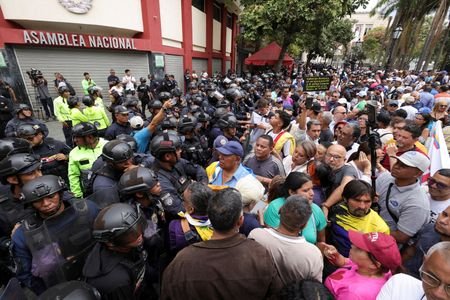
March 12 (Reuters) - A United Nations fact-finding mission said on Thursday that Venezuela's "repressive state" remains fully operational following the removal of former President Nicolas Maduro by U.S. forces in early January.
The mission told the U.N. Human Rights Council in a report that "institutional structures facilitating human rights violations have not been dismantled", adding that 87 politically motivated detentions had taken place since Maduro's ouster.
Venezuela's government has long denied accusations of human rights abuses and the existence of political prisoners, saying those jailed committed common crimes.
The Venezuelan communications ministry, which handles all press queries for the government, did not immediately respond to a request for comment.
The report said senior government and military officials previously identified as responsible for crimes against humanity continue to hold significant power.
Washington has long criticized Venezuela's democratic record, accusing its socialist government of electoral fraud and political repression.
The U.S. announced it would "take control" of Venezuela but has not pushed for new elections, touting good relations with Maduro's vice president Delcy Rodriguez - who has taken over as interim president and has backed major changes to oil and mining regulations, meant to stoke investment.
Rodriguez's government also passed an amnesty law as part of an agreement to free thousands of prisoners. Her administration said in late February that nearly 2,200 people have been released under this law, but local NGOs have criticized a lack of transparency and estimated that the number of freed prisoners is much lower.
Alfredo Romero, the director of legal rights NGO Foro Penal, said at a press conference on Thursday that "there is still a repressive system, a justice system that is used to persecute."
The U.N. mission called for the immediate release of all remaining political detainees and unhindered access to the country to continue its investigations. It did not provide an estimate for the number of people still in prison.
"Venezuela cannot be said to truly be on the road to human rights reform unless and until that repressive apparatus is dismantled," said lawyer Maria Eloisa Quintero, a representative of the mission.
(Reporting by Emma Farge and Natalia Siniawski; Editing by Rosalba O'Brien)