By Laila Bassam, Ahmed Rasheed, Pesha Magid and Tom Perry
BEIRUT/BAGHDAD/JERUSALEM, March 12 (Reuters) - Shi'ite Muslim armed groups in Lebanon and Iraq are stepping up their role in the war with the U.S. and Israel, showing the Iran-backed "Axis of Resistance" can still wage attacks despite damage inflicted on the alliance during the Gaza conflict.
Groups that have long been armed and financed by Iran and loyal to its Shi'ite Islamist rulers are now helping Tehran intensify the war around the region, strikes in recent days show.
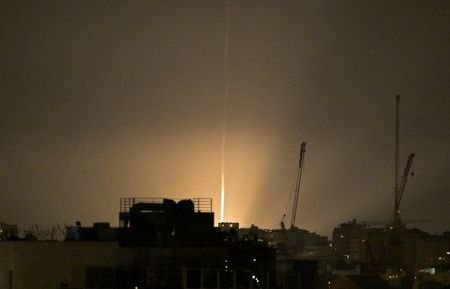
Hezbollah and Iran's Revolutionary Guards on Wednesday launched their first-ever simultaneous rocket barrage on Israel, with the Lebanese group firing 200 missiles. Israel reported that only two of these hit its territory.
Iraqi Shi'ite militants have also picked up the pace of drone and missile attacks on U.S. interests in Iraq in the last 3-4 days, according to three Iraqi security sources and two sources close to the groups.
One group yet to enter the fray are Tehran's Houthi allies in Yemen, heavily armed and capable of disrupting maritime navigation around the Arabian peninsula, as shown during the Gaza war when they fired at Red Sea shipping and Israel. Houthi attacks could further disrupt oil markets because Saudi Arabia diverted exports to the Red Sea after Iran shut the Hormuz straits.
Last week, Houthi leader Abdul Malik al-Houthi said the group had its "fingers on the trigger" and was ready to act militarily when developments warrant it.
The alliance that Tehran calls the Axis of Resistance suffered major blows after Hamas - one of its key members - attacked Israel on October 7, 2023, igniting a war that decimated the Palestinian group and pummelled Hezbollah, with Israel killing the Lebanese group's leader Hassan Nasrallah. The ripple effects helped topple Bashar al-Assad in Syria, knocking away a pillar of the Axis.
"Iran built the Axis for a moment like this," said Mohanad Hage Ali of the Carnegie Middle East Center think-tank, describing it as an "existential war" for Iran and Hezbollah, which joined the fight even though its military power remains well below levels seen in 2023.
"If the Iranian regime is destroyed, there would be nothing left" of the Axis, he said.
Israeli military spokesman Lieutenant Colonel Nadav Shoshani said the Hezbollah attack on Wednesday comprised 200 rockets and 20 drones.
"There's no contradiction between the fact that we heavily, heavily diminished Hezbollah in the last three years, and the fact that they are still a relevant, dangerous force," he told reporters on Thursday.
A U.S. State Department spokesperson said Washington "unequivocally condemns Iran and Iran-backed terrorist militias’ attacks on diplomatic, military, and civilian infrastructure, in Iraq, including in the Iraqi Kurdistan Region", and it fully supports "Israel's right to defend itself against" Hezbollah.
HEZBOLLAH EXECUTES IRANIAN PLAN
Iran's new Supreme Leader Mojtaba Khamenei thanked "the fighters of the Resistance Front", according to a statement issued on Thursday and read out by a state TV announcer.
"We consider the countries of the Resistance Front as our best friends," he said in the statement, the first issued in his name since he was named as leader on Sunday.
Hezbollah, founded by Iran's Revolutionary Guards in 1982, entered the Iran war on March 2, saying it aimed to avenge the killing of Mojtaba's father, former Supreme Leader Ayatollah Ali Khamenei, killed on the first day of the war.
Israel has retaliated with a new offensive against the group in Lebanon, just 15 months after the last one, killing more than 600 people, forcing more than 800,000 from their homes.
Hezbollah's rocket barrage on Wednesday night - its heaviest during this war - was launched at the same time as Iran fired ballistic missiles at Israel, according to the Israeli military and two Lebanese sources familiar with Hezbollah operations.
The Lebanese sources said the coordinated strikes were part of Iran's plan in the event of a major war, aiming to confuse Israeli air defense systems.
Despite the volleys of rockets, Hezbollah's attacks have caused relatively little damage so far. Two Israeli soldiers have been killed in Lebanon.
No fatalities have been reported in Israel as a result of Hezbollah rocket attacks.
LOYALIST CORE MOBILISES IN IRAQ
Hezbollah played a major part in Iran's regional strategy under the leadership of Nasrallah, the secretary general killed in 2024, backing Shi'ite factions in Iraq, Hamas, and the Houthis.
In Iraq, not all the Iran‑backed armed groups appear to support attacks on U.S. interests. Reuters reported last week that many of the fighters and militia groups the Iranians cultivated in Iraq had not entered the fight.
But analysts and officials say a core group of Tehran‑aligned factions remains active and capable of exerting pressure.
Operating under the umbrella of the Islamic Resistance in Iraq, these groups said on Thursday they'd carried out 31 attacks over the past 24 hours using dozens of drones and rockets against what they described as “occupation bases” in Iraq and the region
Security officials say the militias have also sought to extend pressure to energy projects and oilfields in southern Iraq, where several U.S. companies and U.S.‑linked service firms operate alongside international partners.
Among the claimed attacks, two security sources said two drones hit the southern Majnoon oilfield on Wednesday, where U.S.-based KBR is the operator. No casualties were reported. The attack was corroborated by a field engineer who said there had been five such strikes in less than a week.
On Tuesday a U.S. diplomatic facility near Baghdad International Airport was struck by a drone, according to the U.S. State Department, which said there were no injuries and everyone was accounted for.
Four security sources told Reuters the same site has come under repeated attack and was also hit on Wednesday.
Separately, two drones targeted a U.S. military base near Erbil airport in Iraqi Kurdistan on Wednesday, three Kurdish security sources said.
In northern Iraq, a drone attack struck an oilfield operated by U.S. firm HKN Energy in Iraq’s Kurdistan region on March 5, causing a fire and halting production, two security sources and an oilfield engineer said. The sources said the drones belonged to Iran-backed militias and came from an area they controlled.
Reuters could not independently verify who was behind the attacks.
The Islamic Resistance in Iraq also claimed responsibility for downing the U.S. military refueling aircraft on Thursday. The U.S. Central Command said the aircraft crashed in an incident that involved another aircraft but was not the result of hostile or friendly fire.
Andreas Krieg, a lecturer at King's College London's security studies department, said that while the Axis of Resistance had been degraded since 2023, Hezbollah, Iraqi Shi'ite militias, and the Houthis were "very much operational".
"They still retain capabilities, they still show very strong intent, and they remain well resourced," he said.
(Additional reporting by Timour Azhari in Riyadh and Frank Jack Daniel in London; Writing by Tom Perry; Editing by Frank Jack Daniel)