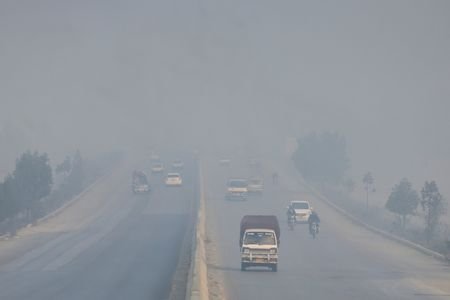
SINGAPORE, March 24 (Reuters) - Pakistan was ranked the world's smoggiest country in 2025, with concentrations of hazardous small particles known as PM2.5 up to 13 times higher than the recommended World Health Organization level, research showed on Tuesday.
Swiss air quality monitoring firm IQAir said in its annual report that 13 countries and territories kept average PM2.5 levels at the WHO standard of less than 5 micrograms per cubic metre last year, up from seven in 2024.
Following are some of the findings of the report:
* In total, 130 out of 143 monitored countries andterritories failed to meet the WHO guideline. * Bangladesh and Tajikistan were second and third on themost polluted list. * Chad, statistically the smoggiest country of 2024, rankedfourth in 2025, but the decline in PM2.5 concentrations lastyear is likely to be the result of data gaps. * Last March, the United States shut down a globalmonitoring programme that compiled pollution data collected fromits embassy and consulate buildings, citing budget constraints. * "The loss of the data in March made it appear there was asignificant drop in PM2.5 levels (in Chad), but the fact of thematter is that we don't know," said Christi Chester Schroeder,lead author of the IQAir report. * The U.S. decision eliminated a primary data source formany smog-prone countries, and Burundi, Turkmenistan and Togowere excluded from the 2025 report because of information gaps. * India's Loni was the world's most polluted city in 2025,with average PM2.5 levels of 112.5 micrograms, followed by Hotanin the northwestern Chinese region of Xinjiang at 109.6micrograms. * The world's top 25 most polluted cities were all in India,Pakistan and China. * Only 14% of the world's cities met the WHO standard in2025, down from 17% a year earlier, with Canadian wildfiresdriving up PM2.5 across the United States and as far as Europe. * Among the countries that met the standard in 2025 wereAustralia, Iceland, Estonia and Panama. * Laos, Cambodia and Indonesia all reported significantPM2.5 reductions compared to the previous year, thanks mainly towetter and windier La Nina weather. Mongolia saw averageconcentrations fall 31% to 17.8 micrograms per cubic metre. * In all, 75 countries reported lower PM2.5 levels in 2025compared to a year earlier, with 54 recording higher averageconcentrations, IQAir said.
(Reporting by David Stanway; Editing by Christopher Cushing)