By Emilie Madi and Maya Gebeily
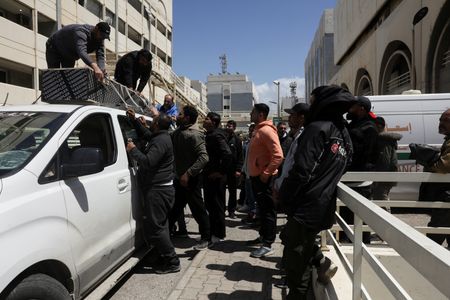
BEIRUT, April 9 (Reuters) - Ambulances arriving at a Beirut hospital on Thursday bypassed the emergency room and drove straight to the morgue, where exhausted medics unloaded a succession of bags of body parts for relatives to identify before burial.
Nearly 24 hours after Israel's deadliest strikes on the Lebanese capital in decades, rescuers were still working to recover mangled bodies from under the rubble of destroyed buildings. More than 250 people were killed across Lebanon on Wednesday, including in strikes on central Beirut that came without warning.
Among them were the brother and teenage nephew of 54-year-old Kheir Hamiyeh. They were both killed in a strike on Hay el-Sellum, a densely populated district of Beirut.
"We are waiting because there's so many people, there are so martyrs... all of them children and women," Hamiyeh said outside the morgue at the Rafik Hariri University Hospital.
The Israeli strike, part of a campaign Israel says is targeting the Iran-aligned Hezbollah armed group, had destroyed their home and wounded his young niece Khadija, who stood next to him with bandages across her face.
"Her father was killed. Her brother was killed. She has one brother left. What are we supposed to do?" Hamiyeh said.
Khadija's mother, Zeinab, told Reuters between bouts of crying that she had to carry the bodies of her husband and 13-year-old son to the ground floor on her own.
RESCUER DESCRIBES PIECING PEOPLE TOGETHER
Lebanon's civil defence service said at least 92 people were killed in Israel's strikes on Beirut on Wednesday. Another 61 were killed in Beirut's southern suburbs.
A rescuer outside the Rafik Hariri Hospital said he had spent all of Wednesday and Thursday trying to pull victims from pulverized apartment blocks across the city.
"We're piecing people together because they're all cut up into different body parts. I've never seen anything like this," said the rescuer, who spoke to Reuters on condition of anonymity because he was not authorized to speak to the press.
Relatives who were waiting at the morgue's entrance were sobbing, calling other family members to tell them they had managed to identify a loved one inside. Three women were crouched on the sidewalk, holding each other upright so they would not collapse.
"The numbers are high, the situation is disastrous and painful," hospital director Dr. Mohammad al-Zaatari told reporters.
He declined to say how many bodies were in the morgue but a rescue worker told Reuters there were at least 100 inside.
Zaatari said anyone with missing relatives should contact Beirut's hospitals, which would begin DNA testing at a later stage to identify any remains that were too distorted to be recognizable.
'THE HOUSES JUST BLEW UP'
Rescuers told Reuters that they had struggled to reach some bombed buildings because streets were so narrow that ambulances and bulldozers couldn't fit.
Nada Jaber told Reuters her nephew had been killed in a strike but that rescuers only managed to pull out his body on Thursday morning. "The houses just blew up," she said.
Hours before the attacks, the Israeli military issued mass evacuation warnings for Beirut's southern suburbs and southern Lebanon, but did not say exactly where it would strike. No warnings were given for central Beirut, which was also bombed.
Abdelrahman Mohammed, a 24-year-old Syrian man living in Beirut since war erupted in his home country in 2011, said he lost five members of his family.
He had just dropped his sister off at her home when an Israeli strike hit their neighbourhood.
"I came back and didn't find the building. I didn't find my sister, and I didn't find my family. Any of them," he told Reuters.
"I don't have any sisters anymore... I came from Syria in 2011 and now I'm going back to Syria carrying five martyrs who are my family," Mohammed said.
Reuters spoke to several other Syrians who said their relatives were killed in the strikes.
"There are many Syrian martyrs, not just my family. A lot. Go ask. It's full of Syrian martyrs. Lebanese and Syrian blood are mixed," Mohammed said.
Israel, which invaded Lebanon last month to root out Hezbollah in parallel with the war on Iran, says its actions there are not covered by the ceasefire announced late on Tuesday by President Donald Trump. Pakistan, which helped mediate the U.S.-Iran talks, has said the truce would include Lebanon.
(Writing by Maya Gebeily, Editing by William Maclean)