By Liz Lee and Phuong Nguyen
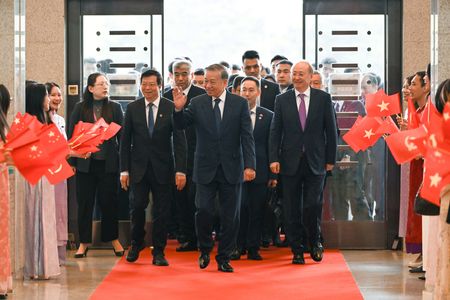
BEIJING/HANOI, April 15 (Reuters) - China and Vietnam should maintain high strategic clarity and prioritise political security, Chinese President Xi Jinping told his Vietnamese counterpart on Wednesday as China-U.S. competition over influence in Southeast Asia grows.
Vietnam's top leader, To Lam, is in China until Friday in his first overseas trip since being elected state president last week.
Vietnam typically balances its engagement between China and the U.S. to navigate their geopolitical rivalry while protecting its economic and security interests.
But Lam's visit is seen as a sign of ties warming further between the two Communist neighbours.
"Both sides must maintain high strategic awareness and strong strategic determination," Xi said, according to Chinese state news agency Xinhua.
Xi also talked about defending the socialist system, closer alignment between the countries' development strategy and greater infrastructure interconnectivity.
The countries signed various cooperation documents across sectors including agriculture, education and railway construction on Wednesday, Vietnamese state media said.
TRADE IS KEY
Lam mentioned boosting investment and technology transfer, and balancing trade ties for deeper economic integration, according to the Vietnam News Agency.
Trade and investment are the cornerstone of China's and Vietnam's relations, with deeply integrated supply chains that made Beijing Hanoi's largest trading partner, and Vietnam the top ASEAN partner for China.
China said it will strengthen cooperation with Vietnam in areas such as artificial intelligence, semiconductors and internet-related industries, while Xi assured that more Vietnamese products were welcome to the Chinese market.
Vietnam's trade deficit with China reached $33.3 billion in the first quarter of 2026, rising 34.4% from a year ago, according to official data.
China and Vietnam have historically oscillated between conflict and cooperation over centuries but have drawn closer in recent years, even as they remain at odds over maritime boundaries in the South China Sea.
The Southeast Asian nation has also been leaning towards a governance model that increasingly mirrors China's, with tightening state oversight while embracing Chinese technology and regulation.
Even the leadership structure appears resemblant when Lam consolidated authority earlier this month, breaking away from the country's traditional collective leadership system.
DEALING WITH MAJOR POWERS
In Vietnam, wary attitudes towards China have softened while tension with the U.S. rose after Trump targeted Hanoi with some of the highest U.S. tariffs imposed in Southeast Asia last year.
Lam's visit highlights how Vietnam is recalibrating its ties with the U.S. and China, said Gregory Poling from the Washington-based Center for Strategic & International Studies (CSIS).
Vietnam trusts neither major power but still needs to work with both, said Poling, who leads CSIS' Southeast Asia program.
"In the new world of U.S. revisionism, keeping China at arm's length in favour of U.S. investment or U.S. preferred standards just isn't seen as viable anymore," Poling said.
(Reporting by Liz Lee and Beijing newsroom, and Phuong Nguyen in Hanoi; Editing by Andrew Heavens and Chizu Nomiyama )