By Chandni Shah
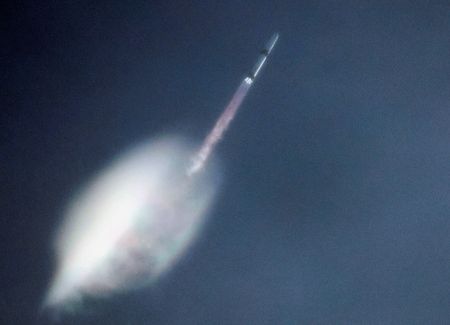
April 19 (Reuters) - The reusable booster of the New Glenn rocket launched from Florida on Sunday by Jeff Bezos' company Blue Origin touched down successfully but the rocket failed to deploy the AST SpaceMobile communications satellite it was carrying into the correct orbit.
The launch was the latest chapter in Blue Origin's intensifying rivalry with Elon Musk's SpaceX. The rocket lifted off at around 7:25 a.m. ET (1125 GMT) from Cape Canaveral, with the booster touchdown coming about 10 minutes later.
New Glenn carried AST's BlueBird 7 satellite to low-Earth orbit. In a statement, AST said that BlueBird 7 was placed into a lower than planned orbit by the upper stage of the launch vehicle.
"While the satellite separated from the launch vehicle and powered on, the altitude is too low to sustain operations with its on-board thruster technology and will (be) de-orbited," AST said.
Designed to connect directly with smartphones, AST's satellite was part of an effort to build a space-based cellular broadband network, similar to Amazon's Leo or SpaceX's Starlink.
'NEVER TELL ME THE ODDS'
Sunday's mission - the third for New Glenn - was key to demonstrating that the 29-story heavy-lift rocket has a reliable booster reuse capability and can compete with the SpaceX Falcon 9 rocket. The rocket's booster, dubbed "Never Tell Me the Odds," previously flew on the second mission in November and was recovered, setting up this milestone attempt.
The booster's name is a nod to a Han Solo line in the film "Star Wars: The Empire Strikes Back."
Following a series of delays this month, the mission came amid a surge of activity in the space sector, including the successful NASA Artemis II lunar flyby that took people further from Earth than any had traveled before.
Blue Origin said in November that it would build a bigger, more powerful variant of its New Glenn rocket, called New Glenn 9x4.
AST SATELLITE CONSTELLATION
New Glenn is designed for the higher end of the commercial launch market with a seven-meter (23-foot) nose cone allowing it to carry bulkier payloads, including multiple satellites in a single mission.
"We foundationally developed New Glenn for what we think space is going to look like 50 to 100 years from now," said New Glenn Vice President Jordan Charles.
AST SpaceMobile's BlueBird 7 is the second satellite in its next-generation Block 2 constellation. The satellite featured what the company describes as the largest commercial communications array deployed in low-Earth orbit.
AST said the company is currently in production through BlueBird 32, with BlueBird 8 to 10 expected to be ready to ship in approximately 30 days.
SPACEX VS BLUE ORIGIN
Reuters reported this month that SpaceX confidentially filed for a U.S. initial public offering targeting a valuation of about $1.75 trillion.
SpaceX and Blue Origin, in the latest competition between the billionaire-run companies, have been racing to help return people to the moon ahead of a planned crewed mission by China in 2030 by designing the lunar landers NASA will use.
In a response to a post on X from Bezos regarding Sunday's launch, Musk acknowledged the launch, congratulating Bezos.
SpaceX is building a massive stainless-steel Starship-based Human Landing System, while Blue Origin is developing a more traditional Blue Moon lander and aims to achieve a pivotal uncrewed soft lunar landing, Mark 1, this summer.
NASA's next Artemis mission planned for next year is expected to test both landers while in Earth orbit before the mission that would return astronauts to the moon for the first time since 1972.
"New Glenn is the vehicle that can take NASA or anyone, anywhere in the solar system," said Laura Maginnis, New Glenn mission vice president.
(Reporting by Chandni Shah in Bengaluru; Additional reporting by Akash Sriram and Gursimran Kaur in Bengaluru; Editing by Jane Merriman, Bill Berkrot and Will Dunham)