By Mei Mei Chu
BEIJING, April 27 (Reuters) - China has used its trade truce with the United States to broaden its legal leverage, supply chain and critical technology controls, and expand its toolkit of retaliatory economic measures ahead of a summit between the nations next month.
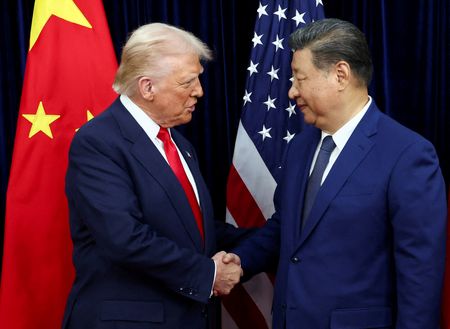
Chinese President Xi Jinping and U.S. President Donald Trump signed an agreement in Busan, South Korea, in October to de-escalate the trade war. The fragile truce is set to expire in November 2026.
Here are the new countermeasures that Beijing has unveiled since signing the truce:
April 15, 2026 - Chinese officials held initial talks with providers of equipment to make solar panels as they consider limiting exports of the most advanced technology to the United States. China is estimated to make more than 80% of the world's solar panel components.
April 13 - China's State Council issued new regulations authorising countermeasures against foreign states for "unlawful extraterritorial jurisdiction".
State media Xinhua reported that the decree could be used against countries imposing secondary sanctions, or the extraterritorial spillover of export controls caused by a country's enforcement of rules like de minimis thresholds.
April 7 - China's State Council issued new regulations on industrial and supply chain security, granting powers to authorities to investigate and take actions against foreign countries, companies, or international organizations that "adopt discriminatory measures" undermining China's industrial and supply chains.
February 24 - China's commerce ministry, in an escalation of a dispute with Tokyo, prohibited the export of dual-use items to 20 Japanese entities that it says supply Japan's military, including vital rare earths used in cars, consumer electronics and weapons.
January 14 - Chinese authorities told domestic companies to stop using cybersecurity software made by more than a dozen firms from the U.S. and Israel due to national security concerns.
January 9 - China began restricting exports of "heavy" rare earths and powerful magnets containing them to Japanese companies.
December 30, 2025 - China requires chipmakers to use at least 50% domestically made equipment for adding new capacity, as Beijing pushes to build a self-sufficient semiconductor supply chain.
November 8 - Beijing's export controls on some high-end lithium-ion batteries, cathodes and graphite anode material as well as technological know-how take effect.
November 5 - China issued guidance requiring new data centre projects that have received any state funds to only use domestically made artificial intelligence chips.
October 30 - Xi and Trump met in Busan, South Korea, and signed an agreement to de-escalate the trade war. Trump agreed with Xi to trim tariffs on China in exchange for Beijing cracking down on the illicit fentanyl trade, resuming U.S. soybean purchases and keeping rare earths exports flowing.
October 9 - China dramatically expanded its rare earths export controls ahead of talks between Xi and Trump, adding five new elements - holmium, erbium, thulium, europium and ytterbium - and extra scrutiny for semiconductors.
The world's largest rare earths producer also added dozens of pieces of refining technology to its control list and announced rules that will require compliance from foreign rare earth producers who use Chinese materials.
(Reporting by Mei Mei Chu; Editing by Christian Schmollinger)