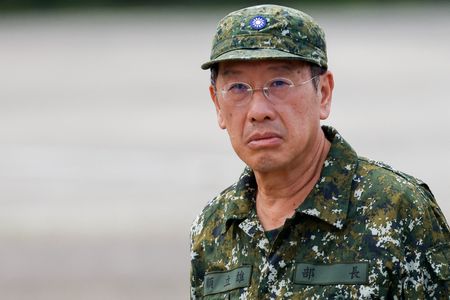
TAIPEI, April 27 (Reuters) - Taiwan's defence minister downplayed on Monday the impact of Chinese sanctions on seven European companies over arms sales to the island, saying it was not the first time China had taken such action and it would not affect Taipei's ability to source weapons.
China's Commerce Ministry banned exports on Friday of dual-use items to the seven companies over arms sales to Taiwan, placing them on its export control list, in a rare case of Europe-targeted, Taiwan-related sanctions.
Taiwan, which China views as its own territory, gets most of its weapons from the United States. Europe has not sold any big-ticket items like fighter jets to Taipei for around three decades, fearful of raising the ire of Beijing.
Taking lawmaker questions in parliament, Taiwan Defence Minister Wellington Koo said it was not the first time China had implemented such measures.
"However, I think such an action, as I understand it, does not affect our ability to continue sourcing goods through relevant diversified channels," he added, without elaborating.
While many countries, especially in Europe, are nervous about any defence cooperation with Taiwan due to fears of Chinese retaliation, Taipei has found an increasingly sympathetic ear in parts of Central and Eastern Europe, especially since Russia invaded Ukraine in 2022.
Four of the seven companies on the new Chinese list are Czech.
China has repeatedly sanctioned major U.S. arms makers over sales to Taiwan, most recently in December following the U.S. announcement of an $11 billion weapons sale package to the island.
JAPAN SCRAPS ARMS EXPORTS CONTROLS
Asked whether Taiwan could start buying weapons from Japan, after Tokyo last week scrapped restrictions on overseas arms sales, Koo said the recipients of weapons exports must be countries that have signed an defence equipment and technology transfer agreement with Japan, which Taiwan has not done.
When asked whether that could happen one day, Koo responded: "In the future, no possibility can be ruled out. I think I can only say that at present, no transfer agreement exists".
While countries such as the Philippines welcomed the change, China expressed deep concern.
Relations between Japan and China have been at a low ebb since Japanese Prime Minister Sanae Takaichi said in November that a Chinese attack on Taiwan threatening Japan's survival could trigger a military response.
(Reporting by Ben Blanchard and Roger Tung; Editing by Kate Mayberry and Raju Gopalakrishnan)