By Karen Lema and Nestor Corrales
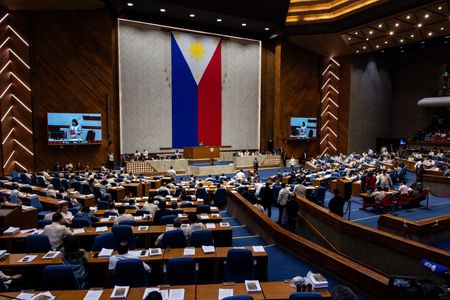
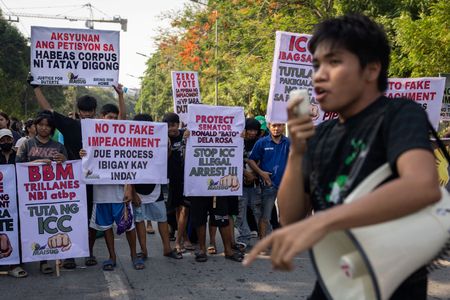
MANILA, May 12 (Reuters) - Philippine Vice President Sara Duterte has again been impeached by the lower house, a little over a year after an earlier impeachment against her was voided on constitutional grounds.
The new complaint once again accused Duterte, the daughter of former president Rodrigo Duterte, of misusing public funds, accumulating unexplained wealth, and threatening the lives of President Ferdinand Marcos Jr, the first lady, and a former House Speaker.
Duterte has denied all accusations. Her lawyers described the complaints as "defective" and characterised the impeachment proceedings as a "fishing expedition".
WHAT HAPPENS AFTER THE LOWER HOUSE VOTES?
Under the Philippine Constitution, once the House impeaches an official, the case is transmitted to the Senate, which must convene as an impeachment court, with senators serving as judges and the Senate president presiding. However, in practice, the process may not be straightforward.
In 2025, the Senate took the unusual step of returning an impeachment case against Duterte to the lower house to clarify its constitutionality. Past impeachment cases have also been derailed when officials resigned before the proceedings concluded.
A notable precedent was the 2001 impeachment trial of then-President Joseph Estrada, which collapsed after prosecutors walked out.
WHAT'S DIFFERENT THIS TIME?
Lawmakers moved ahead with the fresh complaint only after a one‑year constitutional ban on repeat impeachment filings had lapsed, clearing a major legal obstacle that doomed the earlier case. This has raised expectations of a full Senate trial.
But the political landscape has shifted.
Ahead of the House vote, Duterte allies in the Senate backed a leadership change that installed Alan Peter Cayetano, a staunch loyalist of the Duterte family, as Senate president. That means he will be the one who will preside over the trial.
The shake-up was underscored by the sudden return of Senator Ronald dela Rosa, who had been absent from Senate sessions for months before reappearing to cast a decisive vote backing Cayetano, a former running mate of Duterte's father.
Another close Duterte ally, Dela Rosa, had been out of public view since November amid legal pressures linked to an International Criminal Court investigation into the "war on drugs" he oversaw as police chief.
Jean Encinas‑Franco, a political science professor at the University of the Philippines, said the Senate leadership could shape how the proceedings unfold.
"If you are the Senate President or a senator belonging to the majority, you will have the political space to manoeuvre the proceedings of impeachment in a way that will favour whoever your patron is," she said.
WILL THERE BE ENOUGH VOTES TO CONVICT?
It remains unclear whether Duterte's opponents can muster the numbers needed for a conviction.
Supporters of the impeachment say the evidence is overwhelming and could support a guilty verdict. But recent shifts in the Senate's leadership and political alignments have raised uncertainty, with Duterte allies believed to hold significant influence in the chamber.
Analysts say political loyalties in the Philippines are fluid, and senators may calibrate their positions with an eye towards the 2028 presidential election, which Sara Duterte says she will contest.
WHAT HAS MARCOS SAID?
President Marcos has distanced himself from the impeachment effort, saying the process is a matter for Congress, although the case has unfolded against a backdrop of a deepening rift between him and Duterte.
Marcos' communications undersecretary on Tuesday stopped short of explicitly endorsing an impeachment trial, but said allegations should be subjected to proper proceedings.
She stressed that everyone must be held accountable, and hearings are needed to establish the truth.
HOW MANY OFFICIALS HAVE BEEN IMPEACHED IN THE PHILIPPINES?
Duterte is among the highest‑ranking officials to be impeached in the Philippines, alongside former president Joseph Estrada, an ombudsman, former Supreme Court Chief Justice Renato Corona and a former chairman of the Commission on Elections.
Only Corona was convicted. The ombudsman and election commission chief resigned after they were impeached, while Estrada's 2001 trial was aborted after prosecutors walked out.
WHAT IS REQUIRED TO CONVICT DUTERTE?
A two‑thirds majority vote in the Senate is required to convict an impeached official, amounting to at least 16 of 24 senators.
If convicted, Duterte would be removed from her position and could be disqualified from holding public office, potentially ending any plans to run for president.
If the vice president is removed, the president nominates a successor from among members of Congress, subject to confirmation by a majority vote of both chambers, voting separately.
(Reporting by Karen Lema; Editing by David Stanway)