By Christian Kraemer and Holger Hansen
BERLIN, May 13 (Reuters) - German Chancellor Friedrich Merz's cabinet agreed on Wednesday to scrap a contentious heating law and pass measures to boost long-term power generation capacity as it pledged to push on with a package of reforms to revive the struggling economy.
Economy Minister Katherina Reiche said replacing the 2023 law that required new building heating systems to use at least 65% renewable energy would ease the way for companies to invest in construction and building restoration.
"With it, we are creating investment security, we are creating planning security, we are enabling technological openness and flexibility in the choice of heating system," she told reporters.
In addition to the draft heating law, the cabinet approved the creation of a market for standby power generation capacity to back up renewables as coal power generation is phased out, according to government policy.
Under the proposals, operators of power stations or storage facilities would be paid not only for the electricity they supply, but also for keeping capacity on standby for use when renewables are interrupted in periods of low wind or sunshine.
The measures were agreed as the coalition struggles to reverse a sharp slide in its approval ratings that has deepened during months of wrangling over long-promised reforms to the tax, pension, health and welfare systems.
COUNTRY AIMS FOR CLIMATE NEUTRALITY BY 2045
In the face of surging support for the far-right Alternative for Germany party (AfD), Merz's conservative Christian Democrats (CDU) and their centre-left Social Democrat (SPD) coalition partners have both pledged to set aside differences and focus on concrete reform steps.
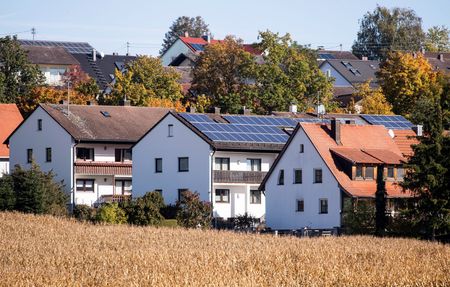
The heating law, passed under the government of former Chancellor Olaf Scholz, drew opposition from conservatives and some media over fears it would force households to scrap gas and oil heaters and spend thousands of euros on new green systems.
Under Wednesday's agreement in cabinet, the law will be replaced by a new building modernisation law that will drop the requirement to include mandatory renewables elements. Households will be allowed to keep existing boilers if they do not choose to switch to alternative systems like heat pumps, district heating and biomass systems.
The new law, which the government said needed to be passed before the start of parliament's summer recess, will require new gas and oil systems to gradually blend in climate-neutral fuels from 2029, increasing their level from 10% to 60% by 2040.
The law, which reiterates Germany's commitment to achieve climate neutrality by 2045, will also implement the European Union's Buildings Directive mandating all new buildings to be zero-emission from 2030.
Germany's BDI industry federation welcomed the change as "an important step towards finally getting investment back on track" and said it would provide a boost to refurbishing Germany's building stock and putting money into construction.
But it was heavily criticized by the Greens' parliamentary leader Katherina Droege, whose party was the driving force of the heating law when it was in government with Scholz, as "a complete abandonment of Germany's climate targets."
(Editing by William Maclean)