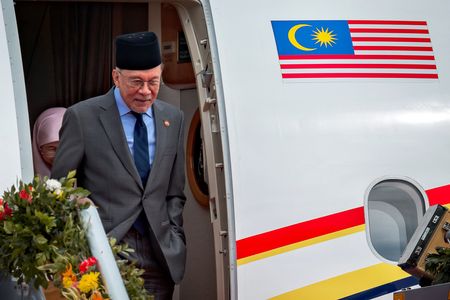
KUALA LUMPUR, June 5 (Reuters) - Malaysian Prime Minister Anwar Ibrahim's ruling coalition will face a test of its public support amid signs of internal tensions after two states this week called snap elections, as speculation mounts over an early national poll.
Two of Anwar's national coalition partners lead the governments in Negeri Sembilan and Johor, where the state assemblies were dissolved on Friday and Monday, respectively, with elections to be held within 60 days.
While the state polls will not directly impact Anwar's majority in the national parliament, any significant losses could weaken his coalition's prospects at a general election due by early 2028. Anwar said last month he would consider calling a snap poll if internal divisions continued to widen within his administration.
Anwar's office did not immediately respond to a request for comment on Friday.
There have been differences in Anwar's ruling alliance, which consists of his Pakatan Harapan bloc, former rival Barisan Nasional, and a handful of other parties, on how to tackle ethnic and religious issues in the multi-racial, Muslim-majority country, and frustration has grown among his progressive allies over the slow pace of reforms.
Anwar has also come under pressure from the once-dominant United Malays National Organisation, which is part of Barisan, over its push for a royal pardon for former prime minister and UMNO leader Najib Razak, who was imprisoned in 2022 for his role in the multibillion-dollar 1MDB scandal.
Pakatan currently governs Negeri Sembilan state, where an election was not due until late 2028, while Barisan leads Johor, where polls were not due until next year.
In what was seen as a sign of the coalition tensions, Barisan has said it would contest the Johor state polls independently without Pakatan's support. In Negeri Sembilan, Pakatan will contest all 36 seats, having won 17 at the last state election.
Two other states, Malacca and Sarawak, are also due to hold elections in coming months. The Election Commission (EC), which will set the dates for the state polls, has said that an early general election would allow state polls to be held concurrently, saving costs.
(Reporting by Danial Azhar; Editing by John Mair)