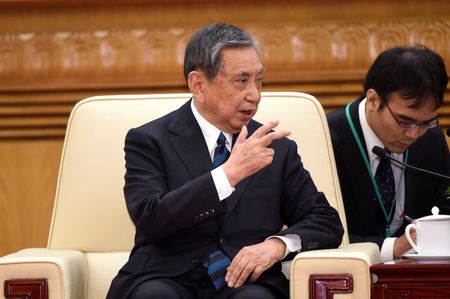
TOKYO, June 10 (Reuters) - Yohei Kono, who as Japan's chief cabinet secretary issued a landmark 1993 apology over women forced to work in wartime military brothels, has died. He was 89.
Local media said he died on Monday, without specifying the cause.
A staunch opponent of efforts by former Prime Minister Shinzo Abe to push for a more muscular military and revise Japan's pacifist constitution, Kono was a rare moderate voice in the conservative ruling Liberal Democratic Party even after retiring from politics.
His standout achievement in a political establishment loth to acknowledge Japan's deeds during World War Two was issuing what came to be known as the Kono Statement in August 1993, the first time the government acknowledged that the Japanese Imperial Army had forced women, many Korean, to work in military brothels.
The plight of the so-called "comfort women" hurt Japan's ties with South Korea for decades.
"The then-Japanese military was, directly or indirectly, involved in the establishment and management of the comfort stations," the statement said, adding that in many cases the women were recruited against their will and that administrative and military personnel took part in their recruitment.
"They lived in misery at comfort stations under a coercive atmosphere," it added.
BUILDING TRUST WITH JAPAN'S NEIGHBOURS
Kono was deputy premier in a coalition government in 1995 when Socialist Prime Minister Tomiichi Murayama issued a "heartfelt apology" for wartime damage and suffering inflicted by Japan.
Other leading politicians rejected such contrition. Abe, who died in 2022, expressed reservations about both Murayama's and Kono's apologies. These have also drawn the ire of conservatives over the years as frosty ties between Japan and South Korea continued over Japan's colonisation of the Korean peninsula in the early 20th century.
A Japanese panel tasked with reviewing the Kono statement said in 2014 that South Korea had helped with the sensitive wording of the original document.
South Korea expressed deep regret over the review, saying the results glossed over the facts, and disputed the finding that Seoul was directly involved in the formulation of the formal apology in 1993.
Prime Minister Sanae Takaichi expressed her condolences for Kono's death on social media on Wednesday evening. "In diplomacy, (Kono) endeavoured to build a relationship of trust with neighbouring countries," Takaichi wrote on X.
"In particular, he faced historical issues sincerely. His emphasis on dialogue and understanding should be remembered as one of the cornerstones of our country's peace diplomacy."
'A FRESH START'
The son and nephew of lawmakers, Kono hailed from Kanagawa prefecture, bordering Tokyo, and graduated from Tokyo's Waseda University. He became a politician in 1967 after the death of his father.
He served stints as deputy prime minister and foreign minister in the 1990s and early 2000s. He was also president of the Liberal Democratic Party from 1993 to 1995, but due to the dominance of other parties in coalition governments, he became one of only two LDP presidents not to become premier.
Kono's son Taro is also a lawmaker. The two made headlines in 2002 when Taro, then 39, donated part of his liver to his father, whose own was failing due to a decades-long hepatitis infection. The surgery was successful.
"Japan made a fresh start 70 years ago based on remorse for that tragic war, the many lives lost and the troubles caused to neighbouring countries," Kono told Reuters in 2015.
"Now Japanese people worry in their hearts that we will somehow set aside that remorse and those memories, and walk the same path as in the past."
(Reporting by Elaine Lies, Linda Sieg and Kiyoshi Takenaka; Editing by Christopher Cushing and Olivier Holmey)