By Joe Cash
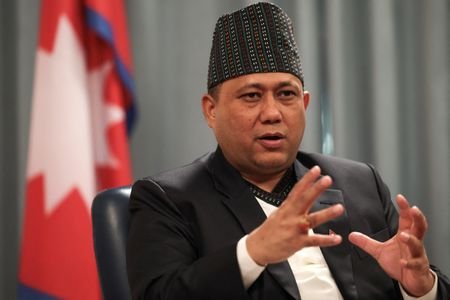
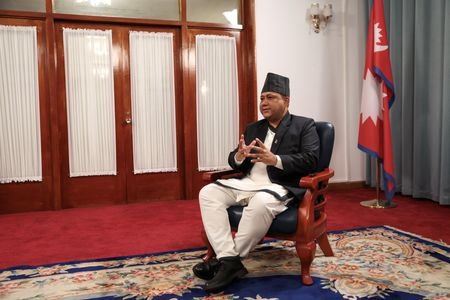
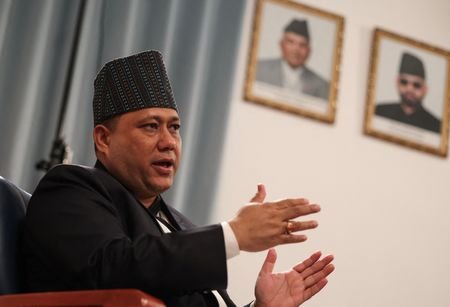
BEIJING, June 16 (Reuters) - Nepal's new government must tap China's technological know-how and convince investors that the Himalayan country is open for business and will deliver on the campaign promises that swept it to power, Foreign Minister Shishir Khanal told Reuters on Tuesday.
The three-year-old Rastriya Swatantra Party won 182 of 275 parliamentary seats in March, campaigning to restore political stability, boost the economy and crack down on corruption, in an election triggered by Gen Z-led protests against the previous government in September that left 76 people dead.
"Our priority is to see Nepal's economy grow fast," Khanal said on his first trip to the neighbouring superpower. "We want to export more, but at the same time, we also want to create jobs at home, so hopefully seeing some investment in Nepal to substitute the imports and create jobs back home."
"Nepal faces a huge trade deficit with China," he said, adding that Nepalese traders had not yet managed to leverage Beijing granting tariff-free access to its $20 trillion economy for over 8,000 goods, citing political instability that has seen 32 changes of government in the last 35 years.
Khanal said he had discussed cooperation in Nepal's agriculture, health and tourism sectors, as well as in science and technology research, in meetings with China’s top diplomat Wang Yi and senior Communist Party official Wang Huning.
The new administration, led by Prime Minister Balen Shah, a 36-year-old former rapper, has made no secret of its push for engagement. Nepal has hosted at least three U.S. officials since April, and the fact that Khanal's first overseas trip was to India may give Beijing pause, analysts said.
Khanal said Nepal would "value its relationship with each country in its own way," later singling out India as a potential export market for energy and China as a key source of tourists.
He confirmed the government was in "active discussion" with Elon Musk's Starlink and China's Huawei over providing internet services, noting that no decision had been made yet and that legal and regulatory changes would be needed, without giving further details.
Beijing had not raised concerns about Musk's system being deployed across China's border, Khanal added, despite having complained about the system at the United Nations.
CHINA REITERATES SUPPORT FOR NEPAL'S INFRASTRUCTURE
"China has always placed Nepal at the forefront of its 'neighbourhood diplomacy'," Foreign Minister Wang Yi told Khanal during a meeting on Monday, according to a foreign ministry readout.
He reiterated Beijing's commitment to building up Nepal's infrastructure, highlighting cooperation in power generation, highways, ports and aviation, although financing disagreements have previously bogged down project delivery for infrastructure earmarked as part of the "Belt and Road" infrastructure initiative.
"Wang Yi wants to make sure that Nepal doesn't swing too far in the direction of either India or the U.S.," said Eric Olander, co-founder of the China-Global South Project, a media and research organisation, adding that Beijing may have been unpleasantly surprised by the Nepalese election outcome.
"Beijing doesn't like change that directly impacts them," he said. "Change that is potentially hostile or challenges their interest is what gets their attention."
"My guess is they didn't see this coming in Nepal and they don't like it when popular movements overthrow incumbent governments."
(Reporting by Joe Cash; Editing by Stephen Coates and Raju Gopalakrishnan)