By Cassandra Garrison and Stephen Eisenhammer
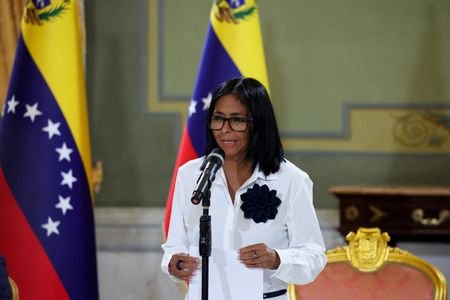
MEXICO CITY, June 26 (Reuters) - Venezuela's strongest earthquake in over a century is the biggest challenge to Delcy Rodriguez's early leadership but could also allow the interim president to stamp her authority on a fractured government and begin rebuilding a broken country.
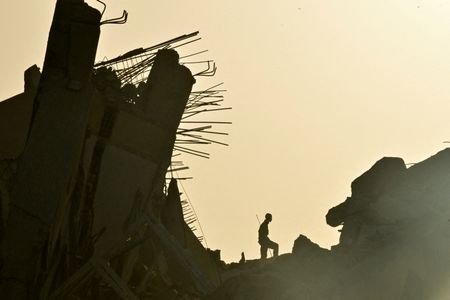
After two earthquakes of magnitudes 7.2 and 7.5 struck Venezuela on Wednesday evening, it could take weeks for the full extent of the damage to become clear. U.S. government data models suggested the death toll could ultimately exceed 10,000.
Even so, some things were already clear. Rescuing those trapped, treating the injured and rebuilding homes and infrastructure will require a vast effort.
That project has the potential to define Rodriguez's political future.
A close ally of U.S. President Donald Trump, she has sought to portray herself as an agent of political change even though she served as vice president to her predecessor, socialist Nicolas Maduro, whom Washington ousted in January.
“The narrative of a new Venezuela is based on reconstruction," said Tony Frangie Mawad, a Caracas-based political scientist. "It ends up being somewhat ironic that the country now has to face, with great difficulty, a very literal reconstruction of its infrastructure."
Frangie said the rescue and rebuilding will face immense challenges given the country's extended economic crisis and weakened public services. It could well end in failure.
“However, if the government manages a recovery strategy well — especially with the international aid that is arriving — and handles the narrative effectively, it could use this moment to build a sense of national unity, a kind of 'rally around the flag' in the face of a natural disaster," he added.
Rodriguez is already attempting to do exactly that. "In unity, we will overcome this situation," she said in the initial aftermath of the disaster.
EARTHQUAKES HAVE BROUGHT CHANGE BEFORE
Major U.S. support could tip the outcome. In 1999, late leader Hugo Chavez rejected U.S. help after deadly landslides killed at least 10,000 people, an early signal of the anti‑U.S. posture that later deepened Venezuela’s isolation.
"It'll be big. It'll be fast, and it'll be effective," Secretary of State Marco Rubio said on Thursday of the U.S. response.
Trump administration aid could increase both the U.S. role in the country and the government's reliance on Washington, according to analysts.
"It’s a situation that is going to be very well exploited to increase the presence of the United States and its control over Venezuela. And also, for Rodriguez to lean on the United States as her primary ally,” said Ricardo Rios, head of Caracas-based consultancy Poder & Estrategia.
Earthquakes have decided political futures in Latin America before.
In 1972, a quake destroyed much of Managua, killing 5,000 to 10,000 people. The corruption-ridden response marked the start of the downfall of President Anastasio Somoza, who would be overthrown by the Sandinista revolution in 1979.
In 1985, Mexico City was devastated by a massive earthquake that killed at least 5,000 people and left some 100,000 people homeless. The failures of the rescue effort were widely regarded as a turning point that led to the end of the PRI's seven decades of one-party rule.
In Venezuela, Rodriguez is likely to be the face of any missteps or mismanagement in the recovery, risking backlash that could shape her political future.
“Venezuela's capacity to handle emergency response has been hollowed out over 10 to 15 years of economic turmoil and displacement of 8 million people beyond Venezuelan borders," said Paul Angelo, a Latin America expert at the Washington-based consultancy McLarty Associates who was in Caracas during the quake.
"Without major international assistance, and without a consolidated plan and lots of money infused into a country that is purportedly $240 billion in debt, this will be a long road to recovery.”
(Reporting by Cassandra Garrison and Stephen Eisenhammer; editing by Christian Plumb and Cynthia Osterman)