By Daria Smetanko and Anna Voitenko
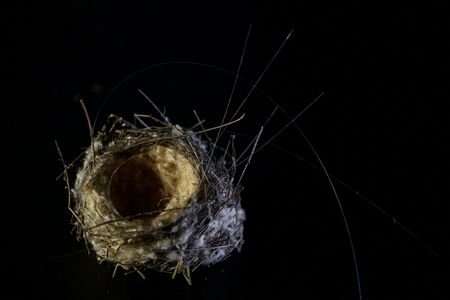
KYIV, June 30 (Reuters) - Woven from fibre-optic cable and grass, a small bird's nest found near the front line of the war in Ukraine shows how the more than four-year-old conflict is reshaping the natural environment, researchers say.
Areas along the 1,200-km (746-mile) front line are covered with ultra-thin fibre-optic cables, which are used by Ukrainian and Russian troops to guide aerial attack drones to make them impervious to electronic jamming.
The cables, which can stretch for 20 km, lie tangled in trees and scattered across fields and on the rooftops of towns in Ukraine's frontline regions, glistening in the sunlight like giant spider web.
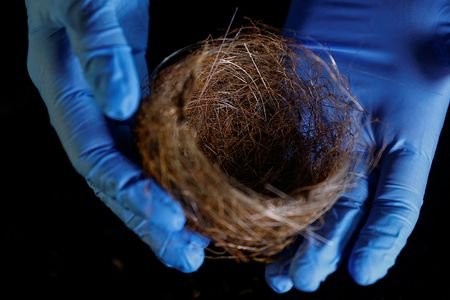
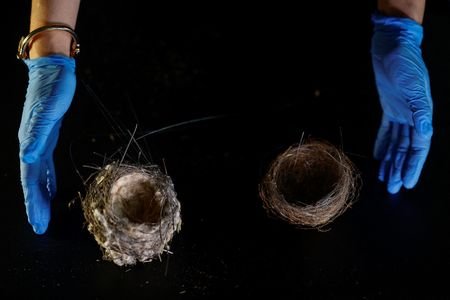
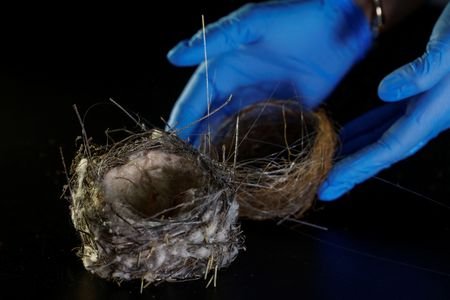
Birds have begun repurposing the discarded cables to weave their nests, says Yana Hrynko, a senior researcher at Kyiv's War Museum, cautiously examining two delicate nests which the armed forces sent to the museum from the front line.
"Objects such as bird nests with fragments of optic fibre demonstrate the change in the nature of war," said Hrynko.
Russia invaded Ukraine in February 2022 with tanks, armoured vehicles and artillery. Trying to counter Russia's advantage in such conventional equipment, Ukraine has poured resources into developing aerial drones. Drones now dominate the battlefield.
Hrynko said researchers did not know which birds made the nests nor how they had gathered the long cables.
"The first nest mainly contains dry grass and fibre-optic cable. And it's pretty tightly twisted," she said.
ONLINE VIDEOS AND PHOTOS
Reuters spoke to several Ukrainian servicemen in the frontline regions of Donetsk, Kharkiv and Zaporizhzhia who had found such nests and posted their pictures and videos online.
One of the two nests will remain in Kyiv as a part of the War Museum's war collection, and the other will be sent for study in the Netherlands and later returned, researchers said.
Auke-Florian Hiemstra, a 33-year-old biologist based in the Dutch city of Leiden who specialises in artificial nest materials, said Ukraine had rich avian biodiversity and there were many species that could have built the nests.
"We're going to look for DNA traces still in a nest to determine who actually made the nest," she said. "I have never seen nests like this before - and I have seen many, many bird nests."
The impact of the fibre-optic on birds could be mixed, Hiemstra said. It could cause harm as the birds could become entangled but it could also benefit them by helping them make a strong nest.
"And by documenting this nest, we're also documenting the impact of war on nature in Ukraine," Hiemstra said.
(Additional reporting by Yuri Kovalenko, Writing by Olena Harmash, Editing by Daniel Flynn and Timothy Heritage)