By Angelo Amante
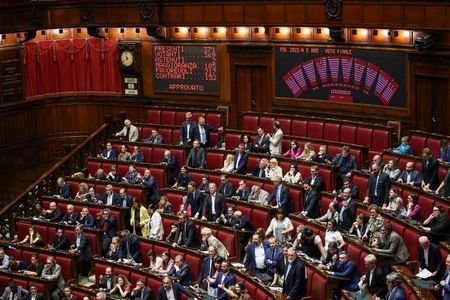
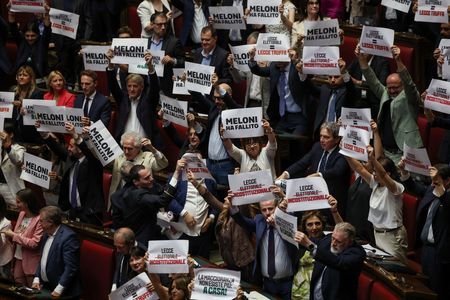
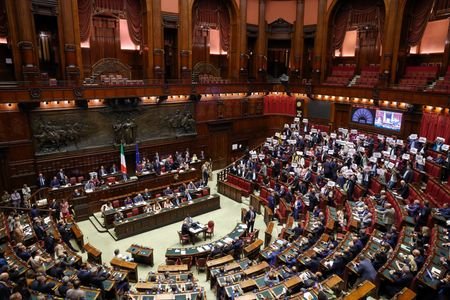
ROME, July 16 (Reuters) - Italy's lower house of parliament on Thursday approved a highly contested government plan to overhaul the electoral law, a move opponents denounced as an attempt to help Prime Minister Giorgia Meloni retain power in the next election due in 2027.
The proposal by the ruling right-wing coalition, comprising Meloni's Brothers of Italy, the League and Forza Italia, would introduce a fully proportional system while guaranteeing a majority to any bloc winning more than 42% of the vote.
Winners surpassing that threshold would receive a bonus of 70 seats in the 400-member lower house and 35 seats in the 200-member Senate. However, their total representation would be capped at 220 and 113 seats respectively, in a bid to avoid overly large majorities.
Debate over the reform exposed tensions within the alliance. On Tuesday, lawmakers rejected a government proposal to allow electors to express preference votes for candidates on party lists, partly due to coalition defections.
NO MORE FIRST-PAST-THE-POST
The bill still requires Senate approval, which the government hopes to secure after the summer recess.
Under the current system, most lawmakers are elected through proportional representation, while roughly a third are chosen in first-past-the-post constituencies that analysts say tend to favour the opposition.
The reform would abolish the first-past-the-post seats, including in southern Italy where the centre-left alliance led by the Democratic Party (PD) and the 5-Star Movement is seen as particularly competitive.
Government supporters say the reform would guarantee that a stable majority comes out of the vote. Meloni is due to become Italy's longest-serving postwar prime minister in early September, after presiding over an unusually prolonged period of stability.
EMERGING FAR-RIGHT FORCE
The rise of a new far-right movement has unsettled Meloni's camp in recent months, siphoning support from the ruling coalition and raising questions about its prospects at the next election.
Futuro Nazionale, led by former army general Roberto Vannacci, is now polling at just over 6%. The party has overtaken the League in some surveys, weakening the coalition as it remains unclear whether Vannacci would ultimately align with Meloni.
According to a simulation by pollster YouTrend, a right-wing alliance including Futuro Nazionale could secure a majority, while the centre-left could prevail if Vannacci chose to run separately.
"The outcome of the next election will depend not only on the electoral law, but crucially on where Futuro Nazionale positions itself," YouTrend said.
(Reporting by Angelo AmanteEditing by Keith Weir)