By Ariba Shahid
KARACHI, July 23 (Reuters) - Pakistan's push to convert some of its diplomatic goodwill with the Trump administration into economic support has drawn skepticism from economists, who say fresh financing will do little to address the reforms that Islamabad has long avoided.
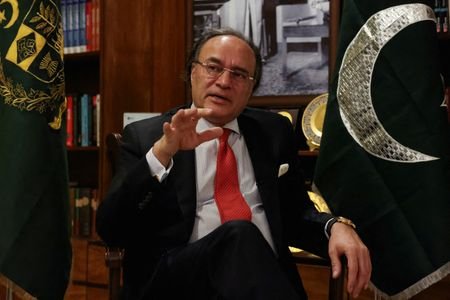
During a visit by Finance Minister Muhammad Aurangzeb to Washington this week, Pakistan requested a $10 billion U.S. exchange stabilization fund, Reuters reported, citing sources with knowledge of the matter who were not authorized to speak publicly about it.
In a previously unreported development, Pakistan later also pitched a separate trade-finance facility with the U.S. EXIM Bank, said a source who was not authorized to discuss the matter publicly. Both proposals would bolster the rupee and diversify funding beyond the International Monetary Fund, China and Saudi Arabia.
Pakistan helped broker a ceasefire between the U.S. and Iran this year, but its economic fundamentals have remained largely unchanged from before the war began.
Amid tensions with the United Arab Emirates, Pakistan repaid Abu Dhabi $3.5 billion in April, a fifth of its reserves, and turned to a $3 billion Saudi backstop to plug the gap.
While it is unclear whether the U.S. will agree to Pakistan's proposals, some analysts see benefits for Washington, too.
The Trump administration has sought a greater role in Pakistan's critical minerals sector, said Uzair Younus, a partner at The Asia Group, adding that the financing is likely to further cement the U.S.' role in potential mining deals.
But others doubt the soundness of any U.S.-Pakistani deal.
Adeel Malik, an Oxford University associate professor, called the proposed reserve facility "geopolitical rent," coming after Pakistan's mediation in the U.S.-Israeli war on Iran and amid a new series of Middle Eastern escalations in recent days.
'VITAL CASH CUSHION'
IMF-enforced reforms have recently shown some impact. S&P Global Ratings on Wednesday upgraded Pakistan to 'B' from 'B-', its first upgrade in nine years, citing stronger fiscal and institutional settings.
But the $7 billion IMF programme carries a political cost: unpopular tax rises and spending curbs as Pakistan's government — already wary of its history of truncated terms — looks towards elections due by 2029.
Gareth Leather of Capital Economics said the proposed U.S. fund would provide a "vital cash cushion" for Pakistan's reserves, without the IMF’s strict conditions or the constant renewal required for Chinese and Saudi deposits.
The EXIM Bank facility, separately, would let Pakistani buyers defer payments to U.S. exporters for one to three years, narrowing the U.S.' trade deficit with the South Asian country.
The real test, however, would not be if fresh money arrives, but whether Pakistan finally delivers on tax, energy and state-owned-enterprise reforms, said Vaqar Ahmed, a Pakistani economist. Without those, he said, Pakistan will keep returning to the IMF.
"Fresh liquidity can buy time, but it cannot buy growth," Ahmed said.
A statement citing the U.S. Treasury secretary praised Pakistan's reforms this week but stressed the importance of greater economic self-reliance and a return to the international capital markets, making no mention of the $10 billion requested facility.
EXIM on Wednesday confirmed talks only on a "strategic framework" targeted for signing at the United Nations General Assembly in September.
Hungary's Viktor Orban, another Trump ally, sought an Argentina-style "financial shield" in November 2025, but Trump did not offer one. Orban's party lost Hungary’s election five months later.
SWAP TALK
At this point, it is unclear what shape such a fund could take in Pakistan's case.
Brad Setser, a senior fellow at the Council on Foreign Relations and former Treasury and U.S. Trade Representative official, said the facility would likely be structured like a maximum draw rather than an upfront dollar transfer.
Treasury's Exchange Stabilization Fund could support it, he said, because Argentina is not drawing on its separate $20 billion line. Argentina drew $2.5 billion in October and repaid it in December, Treasury said.
Not everyone in Washington is convinced the money should flow.
Mark Sobel, a former senior Treasury official who is now the U.S. chair of the OMFIF think tank, said Treasury should decline any swap line for Pakistan despite the countries' security alliance.
Pakistan had become a "permanent ward" of the IMF, he said, having failed to enact reforms despite years of tough lending conditions.
Martin Muehleisen, a fellow at the Atlantic Council and former IMF strategy chief, questioned the scale of the request against Pakistan's roughly $138 billion debt pile.
"For a country the size of Pakistan, you would talk about a few hundred million dollars; $10 billion is just a different order of magnitude," he said, adding that without a strong debt-sustainability framework, it "would probably be a big risk for the U.S. to spend so much money."
NOT AN EXIT
China likely wouldn't be opposed to U.S. help for Pakistan. Yun Sun, director of the China Program at the Stimson Center, said Beijing wants it stabilized but doesn't want to remain its sole backer — and would welcome Washington sharing the load.
Few expect a U.S. exchange stabilization fund to let Pakistan walk away from the IMF and its reforms.
Malik said IMF programmes have become closely aligned with U.S. geopolitical interests in Pakistan and serve as a major lever of American influence, one Washington is unlikely to give up.
Setser said Washington would likely make any funds conditional on Pakistan staying in an active IMF program.
Even that wouldn't necessarily ensure that Pakistan will pursue deeper reforms, however.
The "most conservative use" of any borrowed reserves, Setser said, would simply be to sit on Pakistan's balance sheet, inflating the country's reported gross reserves without addressing what put it there in the first place.
(Reporting by Ariba Shahid in Karachi, Andrea Shalala in Washington; additional reporting by Ankur Banerjee in Singapore; Editing by Rick Noack and Thomas Derpinghaus)