By David Brunnstrom
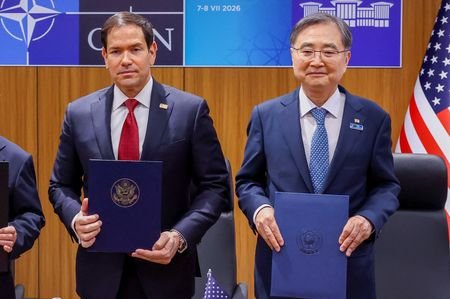
WASHINGTON, Aug 24 (Reuters) - South Korean Foreign Minister Cho Hyun and U.S. Secretary of State Marco Rubio spoke on Monday, and Seoul said they agreed to maintain close communication and cooperation on resolving the North Korean nuclear issue, South Korea's Yonhap news agency reported.
The U.S. State Department issued only a brief statement on the phone call, which comes at a period of tension between the allies. President Donald Trump recently announced a scaling back of joint military exercises and praised nuclear-armed North Korea, while saying that Seoul had not helped his efforts to try to denuclearize Iran.
The State Department said Rubio and Cho discussed "a range of issues in the U.S.-ROK Alliance," referring to South Korea by the initials of its official name, the Republic of Korea.
"The Secretary noted the need for the two countries to remain in close coordination on matters that are integral to the Alliance," it added.
Yonhap said that in a statement on their talks, South Korea's Foreign Ministry did not mention whether the diplomats reaffirmed their usual commitment to North Korea's denuclearization, despite their emphasis on the importance of cooperation on the North Korean nuclear issue.
"The minister and secretary agreed to continue close communication and cooperation between South Korea and the U.S. for peace on the Korean Peninsula and the resolution of North Korea's nuclear issue while maintaining a solid combined defense posture," Yonhap quoted the ministry release as saying.
It cited Cho as saying that Seoul would do its best to help ensure Trump's recent message for North Korea would lead to the resumption of dialogue between Washington and Pyongyang, and peace on the peninsula.
TRUMP'S OUTREACH TESTS ALLIANCE
Trump's olive branch to North Korea's Kim Jong Un last week, coupled with his criticism of Seoul, has raised concern among analysts that Trump's unpredictability could strain alliances that have long maintained peace in Asia.
Cho said last week that Trump's order to curb the military drills appeared aimed in part at pressuring Seoul to support U.S. efforts in the Iran war, alongside other unresolved issues such as investment.
He said one potential source of friction could be South Korea's pledge to invest $350 billion in the United States under a trade deal signed last year.
Seoul has yet to announce details of the investment plan, although Cho said Washington had sent Seoul a proposal outlining projects that could be considered.
Yonhap cited the ministry statement as saying that the two sides agreed to work toward "mutually beneficial" outcomes on various pending issues, including tariffs, investment and security cooperation.
It said Cho underscored the Seoul government's commitment to making substantive contributions to help restore free passage through the Strait of Hormuz, while noting the active leadership of Trump and the U.S. in addressing the Middle East issue.
It said Cho and Rubio agreed to meet in the near future to have in-depth discussions on key pending issues.
(Reporting by David Brunnstrom in Washington and Rajveer Singh Pardesi in Bengaluru; Editing by Tomasz Janowski and Matthew Lewis)