By Andrew Osborn
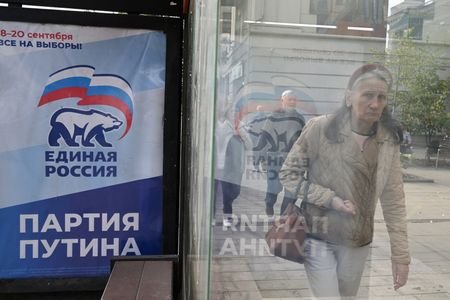
MOSCOW, Sept 18 (Reuters) - Russians are voting in a three-day parliamentary election which is widely expected to see the ruling United Russia party retain its dominance in what is a tightly controlled political system that has excluded most candidates who oppose Moscow's war in Ukraine.
Even though the overall outcome is not in doubt, here are some of the reasons why the vote may be useful to President Vladimir Putin.
A MANDATE FOR MORE WAR?
As president or prime minister for more than a quarter of a century, Putin's grip on Russia has never been tighter. But the war has lasted much longer than many Russians expected and fallout from the conflict is now being felt much more sharply on the home front.
Ukrainian drone strikes on Russia itself have escalated, and while civilian casualties are far lower than in Ukraine, they have sharply increased this year. Strikes on oil refineries have caused fuel shortages, while businesses are grappling with drone attacks on their warehouses and polls suggest some Russians are increasingly anxious.
Having framed the election as a test of support for the war, Putin is likely to point to the results to say that most people back his decision to fight on until key war aims are met.
CREATION OF A 'NEW ELITE'
Putin has said that those who fought in Ukraine are "warriors", part of a new "elite" he has promised will have prestigious careers. Should the some 200 veterans standing from a range of parties do well, Putin is expected to point to their success at the ballot box as an example of how Moscow looks after those who risked their lives for the motherland and to show how distinguishing oneself on the battlefield can lead to a high-profile political career. It's a development that could also encourage more people to sign up to fight in Ukraine.
CONTRAST WITH UKRAINE
Putin has repeatedly suggested that Ukrainian President Volodymyr Zelenskiy is illegitimate, pointing to the fact that his five-year term ran out in May 2024 and that Zelenskiy has refused to hold a new election since. Martial law, introduced in Ukraine in 2022, bans any wartime election and the constitution says the president serves until a newly elected one takes office. But Putin - who has faced criticism from Western politicians about Russia's own political system - may use the vote to say that Russia - unlike Ukraine - has stuck to its electoral timetable regardless of the war and is giving people a chance to vote.
SENSE OF NORMALCY
Putin has been keen to show Russians that despite the conflict and everything associated with it they can largely carry on life as before. Increasingly deep and destructive Ukrainian drone strikes have made that harder to achieve in what is the fifth year of the war. But holding a relatively smooth parliamentary election across 11 time zones in what is the world's largest country, whilst also waging war in Ukraine, could help Putin reassure Russians that pre-war traditions are being respected and that life - up to a point - goes on despite the conflict.
MOBILISATION/CENSORSHIP
Putin this month dismissed suggestions by Ukraine and Western media pundits that Russia would carry out a post-election mobilisation to expand the ranks of its army in Ukraine as "nonsense," suggesting it was a malicious suggestion designed to sow panic.
However, domestic and foreign critics of the war fear he could use the outcome of the election to justify such a move, given what Western intelligence agencies say are heavy Russian losses on the battlefield and what they say is Moscow's desire to urgently speed up the pace of its territorial gains with more manpower.
Those same critics fear that the authorities may move ahead with more repressive measures once the election results are in and a pre-election feel-good mood is no longer required.
They point in particular to plans previously floated by the authorities to have mobile service providers charge customers extra for using more than 15 gigabytes of foreign data in a month, a move seen as targeting people who use VPNs or virtual private networks to access websites and apps banned inside Russia. The authorities have given no public indication they intend to imminently resurrect the plan.
(Reporting by Andrew Osborn Editing by Jon Boyle)