By Jan Wolfe and Patricia Zengerle
Oct 11 (Reuters) - Republican and Democratic US senators called on President Donald Trump on Sunday to "reverse course" on his diesel supply deal with Russia, saying it runs counter to US law barring imports of energy until Russia ends its aggression against Ukraine.
"Congress explicitly banned Russian energy imports in 2022 to prevent American dollars from financing (Russian President Vladimir) Putin’s brutal war against Ukraine," the seven senators - four of Trump's fellow Republicans and three Democrats - said in a statement.
They also said that the administration failed to consult with Congress or submit any explanation of its decision, something also required by law.
"The United States should not provide Putin with a financial lifeline while Russia continues to kill Ukrainian civilians. The Administration must immediately reverse course," the statement said.
It was only the latest bipartisan criticism of Trump's deal, a shift from his party's near-unanimous support for Trump's foreign policy decision weeks before November 3 midterm elections that will determine whether his Republicans will retain their control of Congress.
It was issued by Republican Senators Susan Collins of Maine, Lisa Murkowski of Alaska, Thom Tillis of North Carolina and John Curtis of Utah and Democrats Jeanne Shaheen of New Hampshire, Richard Blumenthal of Connecticut and Ron Wyden of Oregon.
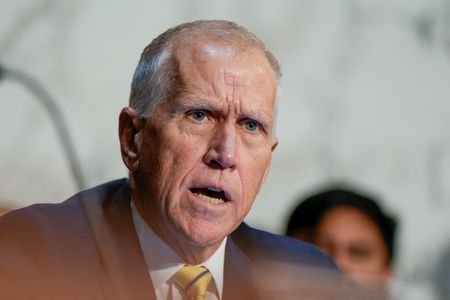
Tillis had said earlier on Sunday that the diesel deal may be illegal and would put American lives at risk.
Trump said on Friday that Russia had agreed to supply diesel to global markets, and his administration temporarily lifted US sanctions on Russian fuel designed to deprive Moscow of revenue for its war on Ukraine.
“I do believe there’s a legitimate case for saying the president’s not following the law,” Tillis, who is retiring from the Senate in January, told NBC's "Meet the Press."
Prices for diesel — used for agriculture, heating homes and trucking — are near record highs and could hurt Republicans in next month's congressional elections.
Analysts have said that Trump's agreement with Moscow was unlikely to lead to sustained lower fuel prices.
ADMINISTRATION DEFENDS PACT
US Treasury Secretary Scott Bessent told Fox News on Sunday that the Trump administration will follow through with the deal using existing legal authority, and the agreement was good for the American people and would bring prices down.
"We're going to do it with all the legal authorities we have. So, you know, anyone in Congress who says whether it's an old bill or the current Lindsey Graham bill (that) prohibits us from doing it is wrong," Bessent told "Fox & Friends."
Trump last month signed a sweeping Russia sanctions bill into law, called the "Lindsey O. Graham Sanctioning Russia and Iran Act of 2026," to honor the South Carolina Republican and longtime Russia hawk who died in July.
Some other Republicans had also criticized the diesel plan. Retiring Representative Don Bacon of Nebraska said on X on Friday that "propping up Putin's war economy is morally wrong as he uses that money to bomb cities."
Mike Pence, Trump's former vice president, called his decision to lift sanctions on Russian oil a "betrayal" of Graham’s legacy and urged the president to "rescind" it.
As Trump's poll numbers have cratered, congressional Republicans have increasingly distanced themselves from the president, on matters ranging from the conflict in Iran to the trade war with Canada.
But the Senate's No. 2 Republican, John Barrasso of Wyoming, defended the diesel pact, telling CBS' "Face the Nation" that Trump is focused on bringing costs down.
"The president is balancing and has to make tough decisions," Barrasso said.
Canadian Prime Minister Mark Carney in a call on Sunday with Ukrainian President Volodymyr Zelenskiy made it clear that the diesel deal "is in direct opposition to the efforts of Ukraine, Canada, and our allies to create peace and stability in Europe," his office said in a statement.
In a social media post on Sunday, Trump claimed that Ukraine and Russia had agreed to what he described as an "energy ceasefire" taking effect immediately, but did not elaborate.
Zelenskiy said he was still waiting to see details of that agreement.
"Ukraine supports the ceasefire, and it is important that Russia support it as well," Zelenskiy said on the Telegram app.
There was no word from Moscow on the announcement, which followed days of US pressure on Ukraine to halt its attacks on Russian oil refineries.
(Reporting by Jan Wolfe and Patricia Zengerle; Additional reporting by Ismail Shakil; Editing by Jesse Mesner-Hage, Susan Fenton, Bill Berkrot and Mark Porter)

