By Emily Rose and Maayan Lubell
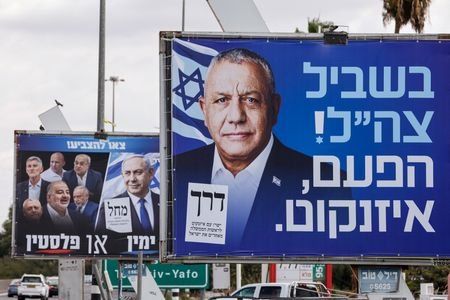
DIMONA, Oct 25 (Reuters) - In the remote Negev Desert town of Dimona, long a bastion of Benjamin Netanyahu's Likud party, disenchanted voters are going door-to-door campaigning for his top rival, hoping to bring down the veteran prime minister in Israel's election on Tuesday.
The ballot is Israel's first since Hamas' October 7, 2023, surprise attack that shook the country and plunged the region into turmoil, as Israel went to war on the militant group in Gaza and its allies in Lebanon and Iran.
The October 7 security breach saw Likud's popularity plummet. Opinion polls for months have predicted Netanyahu's coalition of right-wing, far-right and ultra-Orthodox parties losing its majority. But his top rival, centrist Gadi Eisenkot, has no clear path to power either, and the race has become tighter as the election nears.
Dimona, where an Iranian missile wounded dozens in March, has become a political battleground.
"We must have change. Bibi has to go," said Yossi Assayag, 74, who says he has supported Likud most his life. "Bibi has brought disaster to Israel."
LIKUD LOYALISTS
Assayag is part of a cohort of town residents trying to convince their community to vote for Eisenkot's party Yashar, which is neck-and-neck with Likud in the polls.
It's a tough task in Dimona, where half the voters in the previous 2022 election cast a ballot for Likud.
"I will never betray Likud," said Ruti Ohana, a pensioner, who says she has voted Likud ever since immigrating to Israel from North Africa more than 60 years ago. She said Netanyahu was a cut above his rivals, and the blame he receives from detractors for October 7 was unfair.
Right-wing Likud long ago formed a core voter base among Jews of Middle Eastern and North African descent, known as Mizrahis, who felt neglected by the European-influenced centre-left Labor Party that dominated Israel for generations.
Labor has since dwindled to a rump as Israeli politics have shifted rightwards, and there are now around half a dozen other parties courting Likud voters, from the centre to the far right. But the link to the party among its past supporters remains strong.
"Most people here vote for Likud just because that's how they were raised," said Oria Asaf, 25, a past Likud voter now backing Yashar. "The change will come when people start to think about their children's future rather than their parents' past."
BATTLE FOR WAVERING LIKUDNIKS
While Netanyahu has a hard core of supporters that can't be won over, the prize is undecided voters who "understand that we are in a state of crisis" and are open to persuasion, said Michal Elmalem Abu, elected as a member of the city council from Likud and now leading Eisenkot's Dimona campaign.
Some 13% of Israeli voters have yet to decide how they will vote, according to data collected by the Viterbi Family Center for Public Opinion and Policy Research at the Israel Democracy Institute.
Of those who voted for Likud in 2022, just 55% now say they will vote for the party again on Tuesday. Fifteen percent will support parties aligned against Netanyahu, including 8% for Yashar. Another 14% will vote for alternative right-wing parties, and 9% are undecided.
It is in places just like Dimona where Eisenkot stands a chance to bite a chunk out of Likud's base, said Amotz Asa-El, a political scientist at the Hartman Institute.
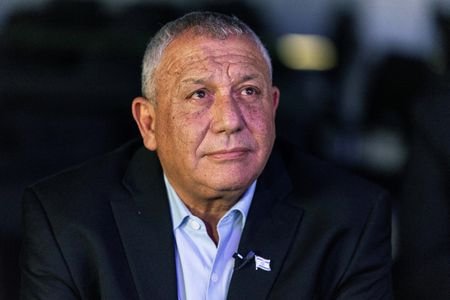
A child of Moroccan immigrants who rose through the ranks to become military chief of staff, Eisenkot, 66, has a personal story of humble origins from the Mizrahi community that "appeals to a big swath of the Israeli electorate, particularly Likud's traditional electorate", said Asa-El.
In an electoral field crowded with ex-soldiers, his peerless security credentials are an asset. The loss of his son, killed in combat in Gaza in December 2023, resonates with voters.
At a town hall during a visit to Dimona in July, residents said they were excited about the prospect of a leader of Mizrahi descent. Others approached him with hugs and tearful condolences for the loss of his son.
But a week later Netanyahu held his own event, demonstrating his powerful appeal in the hardscrabble Negev, where Likud governments have long boasted of bringing development funds.
"Look around you, look at your community, look at what was here then and what is here now, and ask yourselves which governments invested in this monumental effort. And I do this out of immense love," he said.
Lior Katzav, a Likud former mayor of Kiryat Malachi, another small-town stronghold, said party surveys show voters who had abandoned Likud are returning as the election nears.
But even some who are sympathetic to Netanyahu say it may be time for a change. Israel's youngest prime minister when he was first elected 30 years ago, he has since become its longest-serving, now 77, having governed for 18 years over six terms.
"It's time for him to go," said Dimona software engineer David Iskali. "He's done a lot for Israel but it can't go on. I won't give my vote to someone almost 80-years-old."
(Reporting by Emily Rose in Dimona, additional reporting by Maayan Lubell and Tamar Uriel-Beeri in JerusalemWriting by Maayan LubellEditing by Peter Graff)