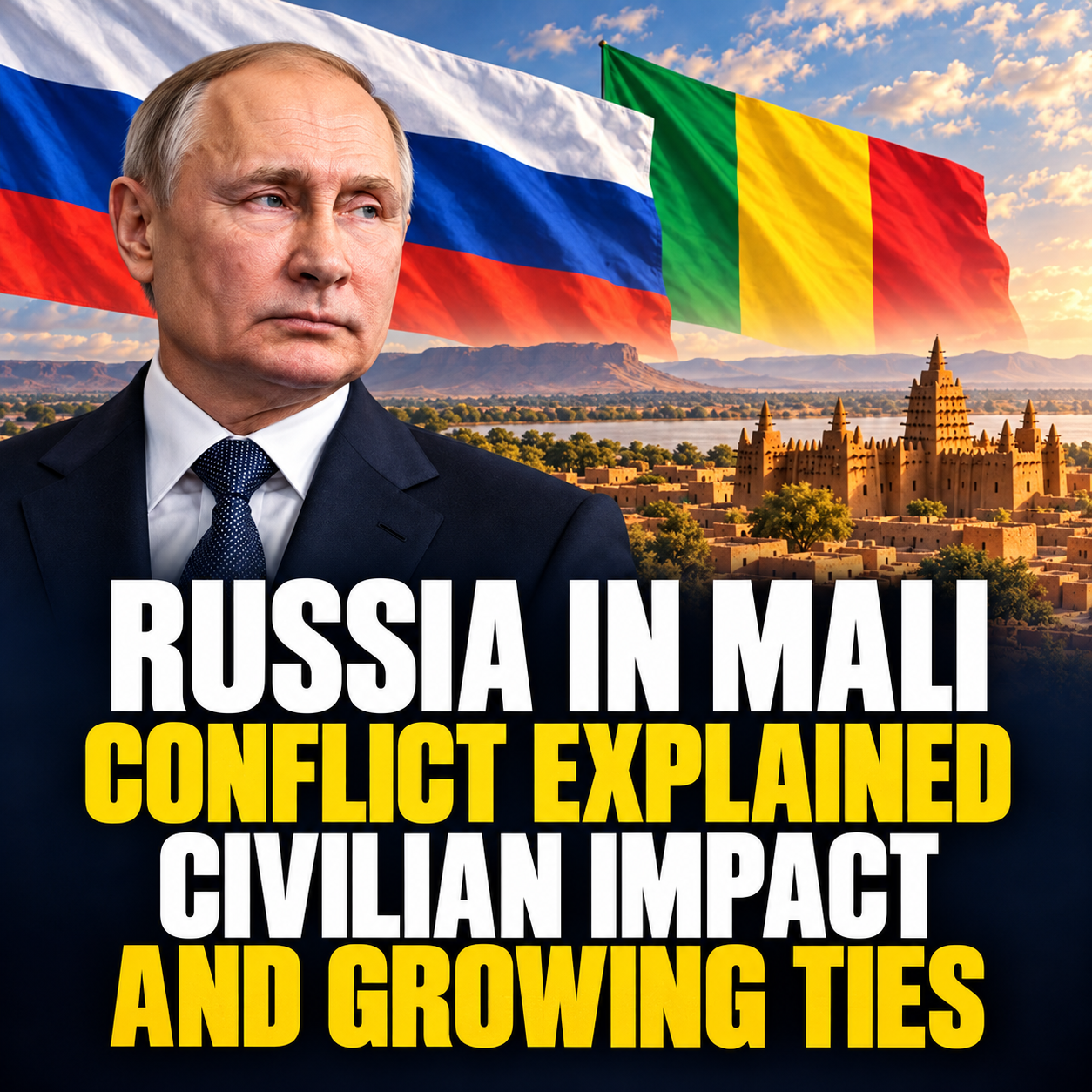
Russia’s partnership with Mali combines military support and growing economic ties. Rights investigations and medical reports show why civilian protection remains central to assessing its impact.
Russia in Mali is expanding beyond military cooperation. Reuters reported on 28 October that state-owned geological company Rosgeologiya had agreed to develop a digital geological map and a mining-sector information system for the West African country. [1]
The agreement comes as Mali’s military leaders and their Russian partners face scrutiny over operations against armed groups. Rights organisations have documented allegations of civilian killings and detention abuses, raising questions about whether stronger military capabilities are translating into safer communities. [2]
Why Russia in Mali has become a major security issue
Mali’s military leadership emerged from coups in 2020 and 2021 and turned towards Russia for support against armed groups. That partnership became a central element of the government’s security strategy. [2]
The principal groups include the al-Qaeda-linked Jama’at Nusrat al-Islam wal-Muslimin, or JNIM, and the Tuareg-led Azawad Liberation Front. Human Rights Watch describes renewed government operations following coordinated attacks by those groups in April. Their different aims and constituencies are important to understanding the conflict. [3]
What is Africa Corps in Mali
Africa Corps is a Russian state-controlled force operating alongside Mali’s military after Wagner’s earlier involvement. Its role places Russia directly within the debate over counterinsurgency operations, the treatment of detainees and responsibility for civilian harm. The conduct of the Malian forces and their foreign partners is a central focus of recent rights reporting. [3, 4]
Civilian abuse allegations and the military response
Human Rights Watch said in a 22 October report that an apparent military drone strike in Guélédié on 16 September killed eight civilians and injured at least six others. It also alleged torture and inhumane detention involving Malian forces and Africa Corps personnel at a military base in Sévaré. [4]
The organisation said it interviewed 15 people remotely and examined visual material. Letters to the Malian and Russian defence ministers had received no response by publication. The report records the Malian military’s account that forces had targeted militants with military equipment and satellite communications near Guélédié. Witness accounts cited by the rights group differ over who was killed. [4]
These findings require investigation and should be distinguished from a criminal court judgment. A separate Human Rights Watch report on 19 October also accused Islamist and separatist fighters of torturing and executing captured soldiers, while documenting alleged unlawful attacks by government forces and their allies. It called for scrutiny of all parties. [3]
How the Mali conflict affects civilians
Medical services provide another measure of the conflict’s cost. In a 24 September update, Médecins Sans Frontières said it was treating wounded people and expanding assistance in central Mali. It described displacement after violence in the Ségou region and preparations for a mobile clinic serving nearly 2,000 displaced people, most of them women and children. [5]
For families living through that insecurity, access to treatment and the ability to move safely are immediate concerns. Displacement and interrupted medical care can disrupt ordinary life long after an attack ends. Assessing security through territorial gains alone would miss those consequences. [5]
What the Russia and Mali economic agreements mean
The geological and mining-data projects widen cooperation into resource information and administration. The announcement does not, by itself, establish Russian ownership of Mali’s deposits or control of particular mines. Its significance should be assessed through the actual agreements and their implementation. [1]
Impact and conclusion
Russia in Mali will be judged by its effect on civilian security as well as the strength of its relationship with the authorities. For local communities, meaningful progress would include safer movement, reliable medical access and credible investigations into alleged abuses by every party.
For Mali and its foreign partners, military assistance and economic projects create responsibilities alongside opportunities. Lasting security depends on public trust and accountable institutions. If cooperation expands while civilian protection remains weak, deeper involvement risks entrenching the conditions that sustain the conflict. The decisive measure is whether people become safer in their daily lives.
Sources and references
[1] Reuters — Russian geological and mining-data agreements, 28 October 2026
[2] Reuters — Mali conflict and Russian support, 19 October 2026
[3] Human Rights Watch — military and insurgent abuses, 19 October 2026
[4] Human Rights Watch — central Mali investigation, 22 October 2026
[5] Médecins Sans Frontières — medical and displacement response, 24 September 2026
Reporting checked on 30 October 2026. Earlier incidents and reports are dated explicitly. Allegations are attributed to the investigating organisation, and the Malian military’s recorded account is included. The closing assessment is analysis.