(Adds TOKYO to dateline)
By Ju-min Park and Tim Kelly
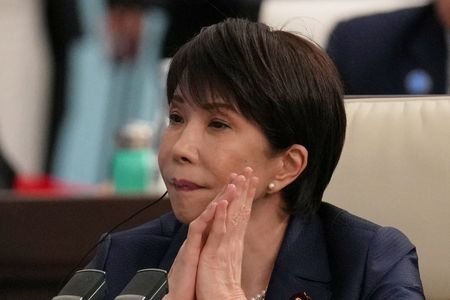
SHENZHEN, China/TOKYO, Nov 19 (Reuters) - From her arrival in China without the fanfare that greeted other world leaders to her seat near the end of a summit table, Japanese Prime Minister Sanae Takaichi cut an isolated figure at the two-day APEC gathering.
Takaichi arrived on Wednesday on her first visit to China since triggering a dispute with President Xi Jinping last year by saying military action against Taiwan could prompt a military response if it threatened Japan's survival.
The row spilled over into trade, with Beijing, Japan's biggest trading partner, curbing exports of critical minerals used in everything from cars and computer chips to jet engines.
On Thursday, Takaichi said her country's position on Taiwan had not changed since 1972.
US President Donald Trump, arriving for the summit, was greeted with music, cheers and pompoms, and in a break with protocol, a personal welcome by Xi.
Australian Prime Minister Anthony Albanese received a bouquet. Despite the Philippines' own fraught ties with Beijing, President Ferdinand Marcos Jr. was welcomed by dancers.
Takaichi, in contrast, got a handshake from a Chinese foreign ministry official and was whisked away in a car.
The cool response continued on Thursday, as leaders gathered for the APEC photo shoot, with Takaichi standing near one end of the back row while Trump, Xi and Russian President Vladimir Putin exchanged handshakes up front.
In the meeting room, Xi sat beside Trump and opposite South Korean President Lee Jae Myung, while Takaichi sat seven seats away near the end of the table.
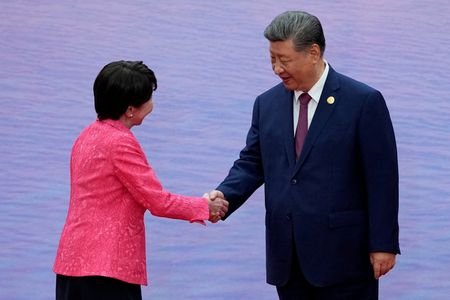
Xi and Takaichi shook hands at Wednesday's welcome dinner and again on Thursday, but held no one-on-one talks to resolve a diplomatic row that looms over Japan's economy.
Asked about Takaichi's frosty welcome, Japanese Chief Cabinet Secretary Minoru Kihara rejected the idea of a diplomatic snub.
"Our understanding is that the host economy extended the customary courtesies to her, just as it did to the leaders of the other economies," he told a regular press briefing.
Japanese media offered a less measured response. China’s "cold shoulder" to Takaichi stood out against Xi's welcome for Trump, the Jiji news agency said.
Kyodo said the young people who waved red bouquets for other leaders were nowhere in sight when Takaichi's plane landed.
Her only bilateral meeting at APEC was a 30-minute exchange with Putin, in which she sought seek the release of a detained Japanese journalist and protections for Japanese companies after Moscow seized assets of Japan Tobacco International.
The aircraft that carried Takaichi to China was the one she had promised during her campaign last year for the leadership of the ruling Liberal Democratic Party to use at least once a month to bolster Japan's presence on the world stage.
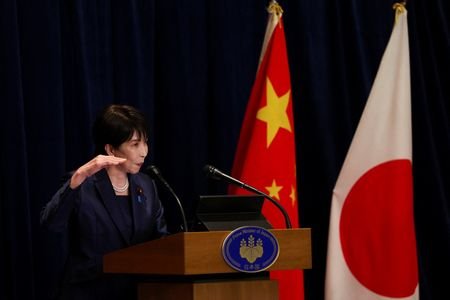
At a press conference at the end of the APEC meet, her 10th overseas trip, Takaichi listed fourteen national leaders she exchanged views with during her overseas trip begun in the Philippines. Xi was not among them.
(Reporting by Ju-min Park in Shenzhen, China and Tim Kelly in Tokyo; Additional reporting by Kaori Kaneko and Laurie Chen; Editing by Clarence Fernandez)