By Ruma Paul
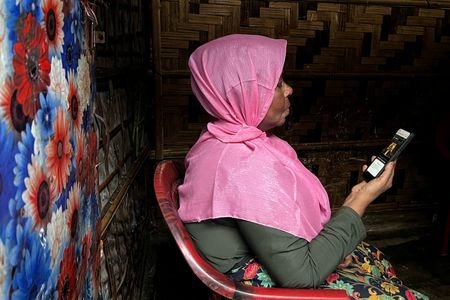
COX'S BAZAR, Bangladesh, Nov 19 (Reuters) - From her ramshackle hut, surrounded by the makeshift homes of more than a million Rohingya refugees like her, Rahama Khatun watched quietly on her smartphone as judges at the United Nations' top court read out a judgement she had long awaited.
"Praise be to God," the 43-year-old widow said on Thursday on hearing the verdict, which marked only the fourth time since the Nazi Holocaust that an international court ruled that the legal threshold to prove genocide had been met.
"My heart is filled with joy to hear that justice is finally being served."
The International Court of Justice ruled that thousands of killings and widespread sexual violence by Myanmar's security forces against the Rohingya in 2017 amounted to state-sponsored genocide, delivering a final verdict in a case brought to the court by Gambia.
Myanmar's military carried out mass executions of men and boys, committed widespread rape of Rohingya women and burned or razed hundreds of villages during so-called clearance operations, the court found.
Myanmar's military-led government did not immediately respond to a request for comment on the ruling.
It has previously described Gambia's allegations as "flawed and unfounded in fact and law" and said its opponents have used "biased reports" based on unreliable evidence.
'TEXTBOOK EXAMPLE OF ETHNIC CLEANSING'
"We have carried this pain for so long," Khatun said ahead of the verdict, describing the moment when Myanmar soldiers came for her husband in their village of Inn Din in Rakhine state, which borders Bangladesh.
At Inn Din, the site of one of several mass killings in Rakhine, Khatun's husband, Shaker Ahmed, 45, as well as her brother and brother-in-law were among 10 Rohingya men killed in September 2017, according to a Reuters investigation.
The military said the men — including fishermen, shopkeepers and students — belonged to a group of 200 "terrorists" that targeted security forces, as part of broader attacks by insurgents that necessitated a response.
The United Nations described the ensuing military crackdown in 2017 as "a textbook example of ethnic cleansing", pushing hundreds of thousands of Rohingya to flee to Bangladesh with harrowing accounts of arson, rapes and killings.
"They killed our men, raped our women and burned our homes," Khatun said. "We lost our loved ones, our land and our livelihoods. The world must recognise what happened and ensure those responsible are held accountable."
Myanmar's military later jailed seven soldiers for 10 years for the Inn Din killings, but they were released early after less than a year in prison.
ESCAPE FROM RAKHINE
Khatun was seven months pregnant with her ninth child when soldiers came for her husband in their village in Rakhine state, a coastal province where generations of Rohingya families have lived alongside the Buddhist majority.
"I begged them not to take him," she said. "I held onto him, but a soldier cut my hand with a machete and dragged him away. That was the last time I saw him alive."
As violence spread across northern Rakhine, Khatun fled Inn Din with her eight children, walking for days through the rain towards Bangladesh.
Her pregnancy made the journey agonising, leaving her legs so swollen that she could barely walk. The family then spent several days stranded on a sandbank near the border, before a boatman took them across to Bangladesh.
RULING RAISES HOPES FOR RETURN TO MYANMAR
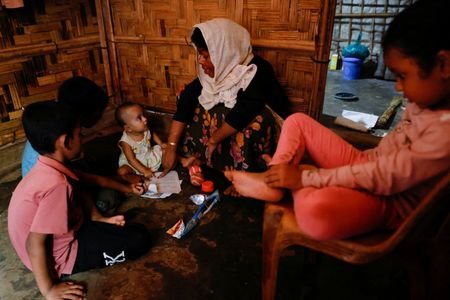
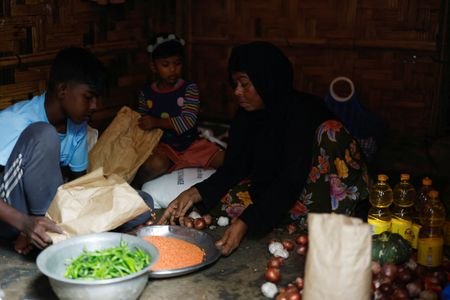
Khatun now lives with her four youngest children, aged 13, 12, 10 and 9, in a cramped bamboo-and-plastic shelter. Her five older children are married and live separately.
After spending nearly a decade in the camps, Khatun yearns to return home to Rakhine, where fighting rages on between the Myanmar military and the Arakan Army rebel group, following a 2021 coup that triggered a nationwide civil war.
"After years of suffering, persecution, and displacement, we hope this historic verdict will pave the way for us to return to our homeland," she said.
"Not as stateless refugees, but as equal citizens with full rights, dignity, freedom, and the citizenship we have always deserved."
(Reporting by Ruma Paul; Writing by Devjyot Ghoshal; Editing by Philippa Fletcher)