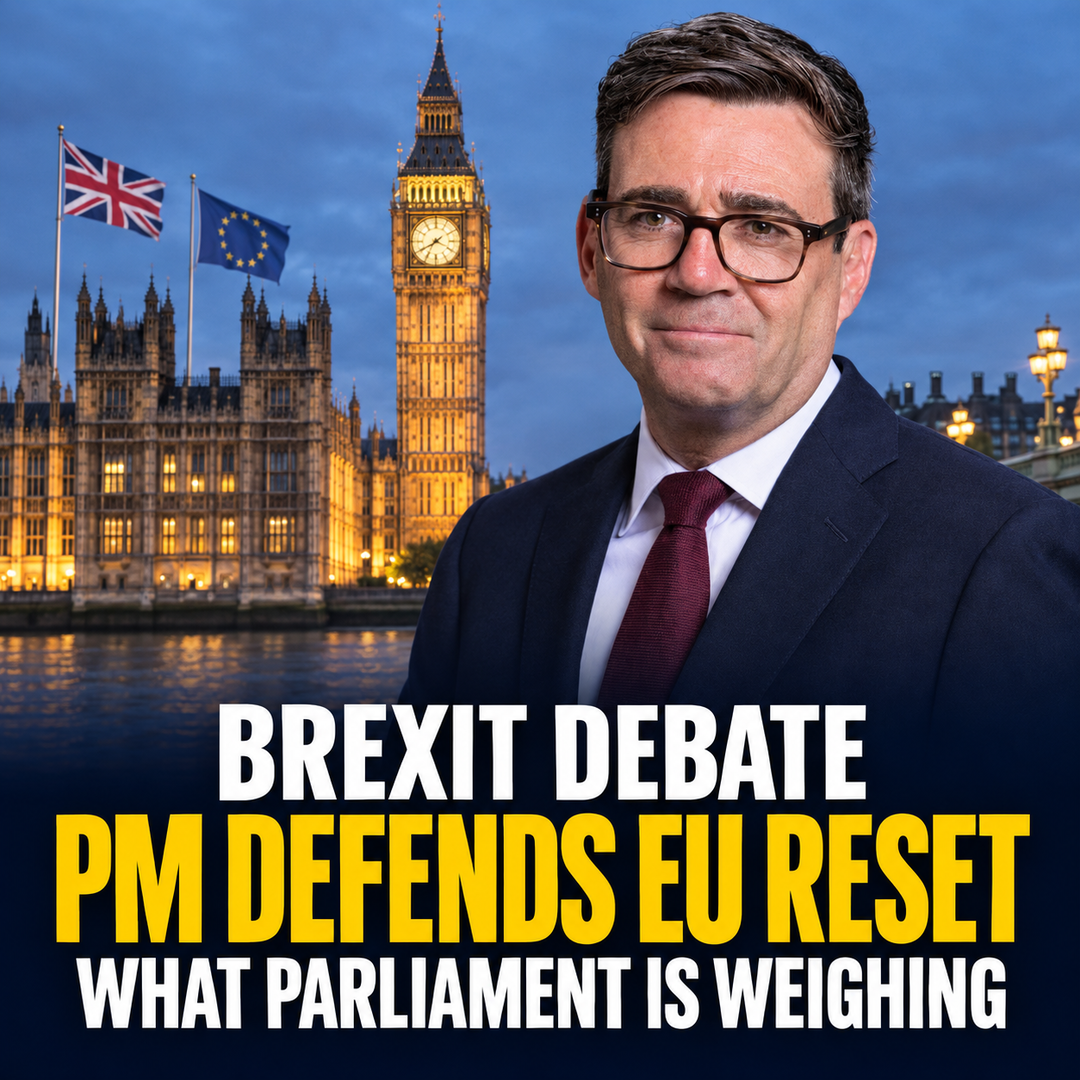
Prime Minister Andy Burnham has defended the government’s UK–EU reset in Parliament while making clear that taking Britain back into the European Union without a referendum would be unthinkable. His position places a distinction at the centre of the Brexit debate: improving the current relationship and deciding on membership are separate questions. [4]
In the Commons statement recorded on 23 November, Burnham presented the agreement reached in Brussels on 20 November as a practical response to barriers facing businesses and young people. As of 25 November, Parliament’s next steps remain focused on scrutiny and implementation. [1, 2]
What the prime minister told MPs
Burnham said the agreement respected Labour’s manifesto commitments and argued that closer cooperation could reduce costs and create opportunities. Questioned directly about a return to the EU without a public vote, he rejected that prospect. The exchange did not announce a referendum or a decision to seek membership. [1, 4]
MPs also challenged the government over the direction of future negotiations. The political argument concerns how much practical cooperation Britain should pursue and what influence it would retain when aligning with EU rules. [1]
What the reset covers
The package includes agreements on food and agricultural trade, emissions trading and a youth experience scheme. These arrangements have their own implementation timetables; the summit announcement does not make every change immediately available. [2]
The House of Lords Library says the food agreement is intended to remove most certification requirements and routine checks on covered agrifood movements between Great Britain and the EU from March 2028. It would also require the UK to follow future EU rule changes in the areas covered. [2]
What happens next in Parliament
Burnham told MPs that the European Partnership Bill, intended to implement the agreement, would be introduced on Thursday, 26 November. The Lords is also scheduled to debate the summit outcome and options for a closer relationship that day. Those are planned parliamentary steps, rather than confirmation that the legislation has already passed. [1, 2]
In his summit speech, the prime minister also emphasised the opportunities he believed the package could create for young people and exporters. Those benefits will depend on the agreements being implemented and on the detailed arrangements that follow. [3]
Impact and conclusion
The reset gives Parliament specific measures to examine alongside the wider argument about Brexit’s future. For households and businesses, the meaningful tests will be changes in paperwork, costs and access to opportunities. Burnham has set out a political position on any future membership vote; the immediate task is deciding how the new agreements should work in practice.
Sources and references
[1] UK Parliament Hansard. UK EU Summit statement and questions. 23 November 2026. Source link
[2] House of Lords Library. UK EU summit and options for developing a closer UK EU relationship. 23 November 2026. Source link
[3] Prime Minister’s Office. PM speech at UK EU Summit. 20 November 2026. Source link
[4] AFP via The News. Burnham says rejoining EU without referendum unthinkable. 25 November 2026. Source link