By Fernando Cardoso and Luciana Magalhaes
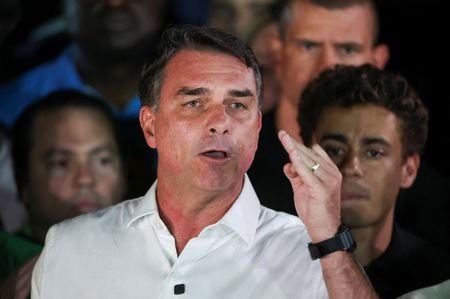
SAO PAULO, Oct 28 (Reuters) - Senator Flavio Bolsonaro declared himself Brazil's rightful leader on Wednesday after arriving in the United States, alleging he was the victim of an electoral coup by the country's Supreme Court and President Luiz Inacio Lula da Silva, who won the vote by over 4 million votes.
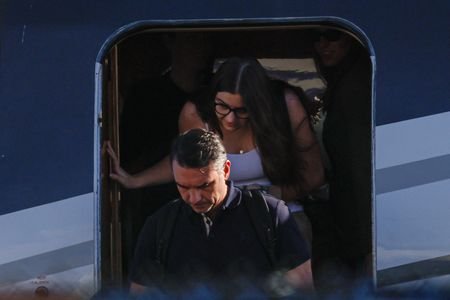
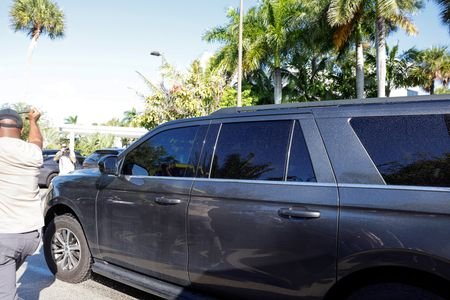
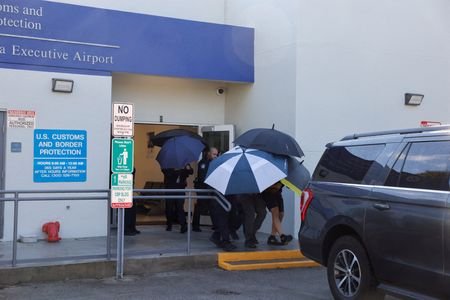
Bolsonaro arrived in Miami after leaving Brazil, where he refused to comply with a Supreme Court order to surrender his passports. He thanked Argentine leader Javier Milei for helping him make the journey and US President Donald Trump, who granted him and his family entry visas, for welcoming him.
In an initial open letter posted on X, Bolsonaro declared himself "the elected president." He then deleted that version and updated it with another letter in which he said he was the rightful "leader" of Brazil.
"I want to say, not only to my 60 million voters but to the Brazilian people, that I am the leader and that the criminals who stole Brazil’s election are part of a criminal organization that has established a tyranny," he said in the updated version.
Lula's victory has been recognized by Brazil's federal electoral court, global leaders, international observers, and Bolsonaro's own party.
Brazil's election took place in full compliance with legal and constitutional requirements, electoral authority chief Kassio Nunes Marques said in a statement, without referencing Bolsonaro's letter.
Asked by reporters at Joint Base Andrews about Bolsonaro's comments, Trump declined to comment, reiterating earlier views that it was "a very strange election."
PROBLEM FOR WASHINGTON
Bolsonaro's declaration poses a problem for Washington as it seeks to navigate a rift with Latin America's largest country, home to the world's second-largest reserves of rare earths.
Lula has accused Washington of colluding with the Bolsonaro family to help return them to power. Ahead of Sunday's election, Reuters reported on a US State Department campaign to restore the Bolsonaros to office. Washington denies meddling in Brazil's domestic affairs.
Trump has previously alleged Flavio's father, former President Jair Bolsonaro, was a victim of judicial persecution.
Jair Bolsonaro travelled to the United States after refusing to concede defeat to Lula in 2022. He eventually returned to Brazil but was sentenced to 27 years in prison for plotting a coup after supporters stormed government buildings in Brasilia.
There was no immediate response from the State Department.
Neither Lula's office nor the Supreme Court immediately responded to requests for comment.
Lula, who served time on corruption convictions that were later annulled, said this week it was "shameful" Bolsonaro had not stayed in Brazil to prove his innocence.
NO PROOF
Bolsonaro left Brazil in secret after the Supreme Court issued the order, which relates to a money-laundering investigation in which he denies wrongdoing.
Bolsonaro, who had been widely expected to win Sunday's election, did not provide evidence for the alleged electoral fraud.
He based his rejection of the result on the fact that a Lula-appointed Supreme Court justice had extended voting by two hours on Sunday due to Lula campaign allegations of voter suppression in left-leaning northeastern states. However, Bolsonaro's campaign also sought an extension due to rain in conservative southern states.
Bolsonaro lost to Lula by around 4.5 million votes. Fewer than 35,000 votes, or some 0.03% of the total, were cast in the extra two hours of voting ordered by the Supreme Court, according to an analysis by Insper professor Pedro Burgos.
Analysts say Bolsonaro's request to annul the election result faces little chance of success.
In his letter, Bolsonaro denied fleeing Brazil, saying he left to protect himself and his family, and to avoid being the victim of a witch hunt he accused Lula and the Brazilian Supreme Court of carrying out.
"I want to make this clear: I did not flee Brazil," he said. "I left Brazil, but I did not abandon the Brazilian people."
(Reporting by Fernando Cardoso, Luciana Magalhaes, Gabriel Stargardter, Additional reporting by Alexandra Valencia in Quito, Gabriel Araujo in Sao Paulo, Maximilian Heath in Buenos Aires, Eva Marie Uzcategui in Miami and David Brunnstrom in Washington and Oliver Griffin in Sao PauloEditing by Ros Russell, Franklin Paul, Aurora Ellis, Rod Nickel)